

Table of Contents
- Welcome
- Introduction
- Beliefs
- Guiding Principles
- Rights and Responsibilities
- The Dignity for All Students Act (DASA)
- Prohibited Conduct
- Digital Citizenship
- Reporting Prohibited Conduct
- Student Behavioral Policies
- Restorative Practices
- Levels of Behaviors and Responses
- The Disciplinary Response Cycle
- Visitor Policies
- Dissemination and Review
- Glossary of Terms
- Appendix
- Policy 5280 – Interscholastic Athletics
- Athletics Ineligibility
- Policy 5280.1 – Mayfield Athletics Policy
About Us Links
Contact Information
District Office
27 School Street
Mayfield, NY 12117
Phone: 518-661-8222
Fax: 518-661-7666
Accessibility Note
If you are unable to access any document on this web page, please contact the Communications Office so that we may provide the information in another format.
Welcome
Dear Students, Families, and Colleagues,
Mayfield Central School District is committed to providing a safe and orderly environment for our students and staff where we deliver quality educational services without disruption. To achieve this we must define a set of expectations of responsible behavior.
I am pleased to introduce our district’s new Code of Conduct, Character, and Support. In this document we establish our district’s values, goals and expectations, and clearly outline our plan and rules for upholding them and maintaining a positive and respectful environment. The Code of Conduct, Character, and Support applies to all students, school personnel, parents and visitors when on school property, in school vehicles or in attendance at a school function.
The new Code of Conduct, Character, and Support also places greater emphasis on the value of social and emotional supports and restorative practices. This ensures that our school provides equal access to a wide range of supports and interventions that promote positive and responsible interactions, enabling students to correct inappropriate behaviors and achieve greater success at school and in their future.
I feel honored to lead a district with a long-standing commitment to community and the success of its students. It is important that the school community adhere to the Code of Conduct, Character, and Support to ensure that our shared values are upheld and that we continue to make Mayfield a place we are all proud to be a part of.
Sincerely,
Christopher Clapper
Superintendent of Schools
Introduction
The goal of the Mayfield Central School District Code of Conduct, Character, and Support is to ensure that the right of all students to receive an education in a safe, civil, engaging, and caring environment is met. For our schools to be safe and supportive environments, everyone within the school community needs to demonstrate and offer respect.
The Code of Conduct, Character, and Support serves as a guide to good citizenship, promoting positive behavior and helping students understand expectations that are based on the principles of mutual respect, citizenship, character, acceptance, honesty, and integrity. Students are expected to conduct themselves in an appropriate and civil manner, with proper regard for the rights and welfare of other students, school personnel, and other members of the school community, as well as for the care of school facilities and equipment.
The Board of Education recognizes the need to clearly define expectations for acceptable conduct and identify the potential responses to unacceptable conduct. Levels of behavior concerns, violations, responses, interventions, and consequences are outlined in the Code of Conduct, Character, and Support.
The Code of Conduct, Character, and Support applies to all students while in Mayfield Central School District schools and on school grounds, in school vehicles, at school-related and district-sponsored activities, including those held at locations off school property. It also applies to actions that occur outside of school hours and off school property when behavior can negatively affect the educational process or endanger the health, safety, morals, or welfare of the school community.
Our Code of Conduct, Character, and Support also emphasizes the importance of implementing strategies, practices, interventions, and plans that address students’ needs before behavior issues rise to a more serious level. Students are most likely to make positive decisions when they understand the expectations, know that adults care about them, and feel respected.
Our top priorities are to ensure that our schools are safe, that all students have what they need to be academically successful, and that race, ethnicity, economics, and disability are never predictors of student achievement.
The Mayfield Central School District Code of Conduct, Character, and Support ensures that students have equitable access to behavioral support and intervention and that race, weight, national origin, ethnic group, religion, religious practice, disability, sexual orientation, gender, or gender expression are not predictors of student achievement.
Beliefs
All of our students must be assured that they will be treated in a fair, consistent, and non-discriminatory manner. We must ensure that all students have what they need to be academically successful. Supporting positive behavior requires a high level of commitment from students, parents, guardians, staff, administrators, and members of the Board of Education.
- Equity is the main pillar of our work. This includes:
- Work to eliminate the disparity in opportunities and ensure success for all students.
- Interrupt recurring practices that negatively impact students from diverse backgrounds and experiences.
- Cultivate the unique gifts of each student.
- All children can achieve their personal best and can improve their behavior with guidance, instruction, support, and coaching.
- Students are best approached through a trauma-informed lens. For example, they should not be asked, “What is wrong with you?” They should instead be asked, “What has happened to you?”
- Students need varying kinds and amounts of time, attention, and support to succeed academically and achieve at high levels.
- Students are more likely to make positive decisions when:
- They understand the positive behaviors that are expected of them.
- They feel that staff members care about them and will help them learn and grow.
- They feel respected.
- All staff consistently use best practices.
- All staff provide positive feedback for appropriate behavior and effort.
Guiding Principals
The Mayfield Central School District Code of Conduct, Character, and Support is based on key principles for ensuring that our schools are safe, healthy, and supportive environments.
All adults have an obligation to help students learn to be good citizens by:
- Helping students learn right from wrong.
- Fostering a desire to make good decisions.
- Encouraging them to take responsibility for their actions and words.
- Modeling behaviors that we want to cultivate.
Policies and practices must be implemented in ways that are consistent, fair, and respectful. Adults are expected to protect the dignity of every student and ensure a tone of decency, compassion, and respect.
Improving educational outcomes for all students requires that schools provide support, and that behavior support is directed at addressing academic learning gaps, lagging skills, and the causes of misbehavior. Prevention and intervention strategies may include more personalized instruction, support services, and programming to address personal and family circumstances and social-emotional learning. Examples of strategies include conflict resolution, academic intervention, tutoring, peer mediation, anger management, positive behavior strategies, circles, and other restorative and therapeutic interventions.
School personnel are responsible for developing, teaching, and using strategies that promote productive learning and positive behavior in school, as well as addressing behaviors that disrupt learning. Therefore, administrators, teachers, counselors, social workers, psychologists, outside consultants, coaches, other school staff, and parents are expected to lay the groundwork by engaging students in interventions and prevention strategies that support positive behaviors and relationships to assist students both day to day and at critical points in their lives.
Guiding Principles: Diversity, Equity, Inclusion, and Belonging (DEIB)
The Mayfield Central School District defines equity as our commitment to ensuring that all students are able to fully access educational experiences and services in our schools, and understanding and eliminating barriers to achieving this. It is doing everything it takes to ensure that all students feel valued, safe, and welcome. Equity is not giving all students the same experience; it is about giving each student what they need so that they can meet their potential and have full access to the opportunities that make up a Mayfield education.
This requires building authentic relationships with students and families and embracing the unique perspectives and contributions of all in our community.
Our commitment to diversity and equity will help guide how we create and implement student discipline, policies, and practices. This means working with parents, guardians, and caregivers as partners when addressing student behavior issues. Also, it means further developing our capacity as culturally responsive practitioners in and outside of the classroom.
Guiding Principles: Social Emotional Learning (SEL)
Mayfield Central School District is invested in supporting students to develop self-awareness and self-management skills essential to success in school and in life. This support is integrated into our daily interactions with students, promoting social awareness and interpersonal skills that establish and maintain positive relationships. Mayfield Central School District encourages all students to develop and demonstrate ethical decision-making skills and responsible behaviors in personal, school, and community contexts.
The ability to recognize the thoughts, feelings, and perspectives of other individuals, including ideas and viewpoints that are different from one’s own, and to empathize with others from diverse backgrounds, is central to forming and maintaining positive relationships at all life stages.
Guiding Principles: Prosocial Behavior
The Mayfield Central School District is expected to promote a positive school climate and culture that provides students with support so that they can grow both academically and socially. Schools are expected to take a proactive role in nurturing students’ prosocial behavior by providing a range of positive behavioral supports as well as meaningful opportunities for social-emotional learning. Effective social-emotional learning helps students develop fundamental life skills.
Guiding Principles: Student Engagement
Engagement is integral to creating a positive school climate and culture that effectively fosters belongingness, academic achievement, and social-emotional growth. Providing students with ample opportunities to participate in a wide range of pro-social activities and develop a bond with caring, supportive adults positively influences behavior. A few examples include providing students with opportunities to share ideas and concerns and participating in school-wide initiatives.
Guiding Principles: Expectations, Respect, and Accountability
It takes the commitment and responsibility of all staff for the healthy development of students, including modeling the skills, behaviors, and mindsets that they seek to cultivate in students. All staff members are urged to set high expectations for student success, build positive relationships with students, and model how to behave successfully in school settings.
Guiding Principles: Restorative Practices
The approach to student discipline, policies, and practices should originate from a place of prioritizing accountability and should be restorative in nature. Students and families need to know that the school will provide interventions inside and outside the classroom that support a restorative, rather than punitive, response. Students have the opportunity to accept assigned consequences and fully participate in the interventions designed to address specific behaviors. Such interventions require students to own the problem, reflect on the impact of their behavior on themselves and others, ultimately understanding why the demonstrated behavior was unacceptable or inappropriate. It does not mean there are no other consequences to the behavior, but it is commonly accepted that administering consequences without re-teaching and reflection does little to change behavior in the long run.
We need to be aware that the person whose actions we are attempting to correct has to be in a place where they can genuinely admit wrongdoing and learn to make amends or alter their behavior. Questions to be considered during the process of corrective action are:
- What happened?
- What were you thinking about at the time?
- What have you been thinking about since?
- Who has been affected by what you have done?
- In what way have they been affected?
- What needs to be done to make things right with this teacher, student, or another person so you can access your education?
Restorative practices and the skilled use of affective statements* fall on a continuum of complexity and appropriateness that can lead to restorative justice outcomes. Well-utilized and appropriately implemented strategies can avoid negative outcomes that may lead to larger offenses that would usually involve long-term suspension or involvement with law enforcement.
Examples of restorative practices that may be used:
*Affective Statements refer to the tone in which students are spoken to that encourages healthy relationships and demonstrates sincere and caring messaging. For example, “I liked the way you worked for the whole class period today,” is more specific and clear than simply saying, “good job.”
Circles can be used proactively to build relationships in a non-stressful and engaging environment. Students and teachers can prevent escalation, reduce violence, and create a culture of peace while cultivating respect and classroom norms by sharing and participating in various mindful activities. These circles could be used from the beginning of the school year so that students understand how they work before significant issues need to be discussed.
A restorative conference is a formal response to wrongdoing where the facilitator helps all parties explore what happened and who was affected. This can be done with a facilitator, teacher, and a student after a disruption to the learning environment has occurred.
Restorative reflections are an exercise in which students complete a writing assignment and go through the restorative questions and steps as they try to reflect on their actions and make a better plan for the future.
The district will support this by:
- Leading training opportunities for staff.
- Providing resources for meeting the goals of the Code of Conduct, Character, and Support.
- Continuing to build community partnerships.
- Engaging in creative thinking to support all students.
- Creating professional development opportunities for school teams to collaborate.
- Sharing data and reviewing other district schools’ implementation and practices.
Rights and Responsibilities
All members of the school community must assume a responsible role in promoting behavior that enhances academic and social success. Courteous, respectful, and responsible behavior fosters a positive climate and one that promotes learning.
Students
- Students learn best when adults serve as active, positive role models.
- Students learn best when they learn to celebrate differences.
- Students learn best when respect and civility are modeled by all.
- Students learn best when expectations are clearly defined and consistently enforced.
All students are guaranteed the right to express opinions, support causes, organize and assemble to discuss issues, and demonstrate peacefully and responsibly in support of and in accordance with policies and procedures established by the Mayfield Central School District Board of Education.
Students have the right to:
- Be afforded a sound, quality education in a school environment that is safe, orderly, and promotes learning.
- Be respected as an individual, treated fairly and with dignity by other students and school staff.
- Organize, promote, and participate in student activities and clubs as part of the formal education process or as authorized by the school principal.
- Provide representation on appropriate school-wide committees that influence the educational process as designated by school personnel.
- Participate and express opinions through the publication of school newspapers with oversight and approval from faculty advisors and administrators.
- Exercise freedom of inquiry and expression, written and oral, within appropriate limits under the law, and provided that the rights of others are not diminished.
- Be protected from intimidation, harassment, or discrimination based on actual or perceived race, color, weight, national origin, ethnic group, religion or religious practice, sex, gender, gender identity, sexual orientation, or disability, by employees and students on school property or at any school-sponsored event, function, or activity.
Students have the responsibility to:
- Own and be active participants in their learning. Attend school daily, arrive on time, and be prepared to learn.
- Be truthful and accountable for their words and actions. Respect themselves and others in class, on school grounds, on buses, and in any school-related activity.
- Respect the rights and feelings of fellow students, parents, school staff, visitors, and guests.
- Know and comply with school district rules and policies.
- Make an effort to correct and improve behavior through restorative interventions.
- Express thoughts and opinions in ways that are respectful.
- Respect others’ personal space. Taking care of property that belongs to others or the school.
- Participate in learning communities, including helping to formulate rules and procedures in the school, engaging in school-related activities, and fostering a culture of respect for learning and for others.
- Seek help and assistance when needed.
- Help to make school a community that is free from violence, intimidation, bullying, harassment, and discrimination.
Parents, Guardians, and Caregivers
Parents, guardians, and caregivers have the right to be active participants in the learning process, to express views, and to provide input into decisions that affect their children. They are vital to the success of students in school. Parents, guardians, and caregivers should have high expectations for their children. They are always welcome into our schools.
Parents, Guardians, and Caregivers have the right to:
- Be actively involved in their children’s education.
- Be treated courteously, fairly, and respectfully by all school staff.
- Receive timely information about policies and procedures that relate to their children.
- Receive regular reports from school staff regarding academic progress and behavior.
- Receive notification and information of inappropriate or disruptive behaviors by their children and disciplinary actions taken.
- Receive information about due process procedures for disciplinary matters concerning their children.
- Receive information about ways to improve their children’s progress, including counseling, tutoring, after-school programs, academic programs, and mental health services.
- Receive information about services for students with disabilities and English language learners.
- Be contacted when their child is believed to have committed a crime or when police are called.
- Receive communication through the provided translators.
Parents, Guardians, and Caregivers have the responsibility to:
- Provide updated contact information to the Mayfield Central School District Student Registration Office and their child’s school.
- Make sure that their children attend school regularly and on time.
- Let the school know when and why children are absent. Please call 518-661-8222.
- Tell school officials about any concerns or complaints.
- Support their children by providing an environment suitable for learning and developing good study habits.
- Work with school staff to address any academic or behavioral problems their children may be facing.
- Talk with their children about behavior expectations.
- Teach and model respect.
- Advocate for their children and take an active role in the school community.
- Attend parent/teacher conferences and monitor their children’s grades and progress.
- Be respectful and courteous to staff, other parents, guardians, caregivers, and students while on school premises or when participating in school-related events.
- Teach children that all children have the right to attend school and be treated with respect and dignity, regardless of race, color, weight, national origin, ethnic group, religion, religious practice, disability, sexual orientation, gender/gender identity, or sex.
Educators (Teachers, Principals, Coaches, All School Staff)
Educators (Teachers, Principals, coaches, Support Professionals & All Staff) have the right to:
- Work in a safe and orderly environment.
- Be treated courteously, fairly, and respectfully by students, parents/guardians, and other school staff.
- Communicate concerns, suggestions, and complaints.
- Receive supportive professional development and training.
- Receive necessary resources.
Educators (Teachers, Principals, coaches, Support Professionals & All Staff) have the responsibility to:
- Foster and nurture so that students develop as learners both academically and socially.
- Recognize that children should be subject to behavior management, support, and discipline policies appropriate to their ages and levels of understanding.
- Be respectful and courteous to students, parents, guardians, and caregivers.
- Serve as role models for students.
- Cooperate and schedule conferences with students, parents, and others in an effort to understand and resolve academic and behavioral concerns.
- Make efforts to accommodate families whose work schedules, access to transportation, or distance from school limit their ability to meet or participate.
- Provide parents access to information regarding their student’s progress, challenges, effort, and achievements.
- Encourage students to participate in classroom, extracurricular, and other school-related activities.
- Know and enforce rules, policies, and procedures consistently, fairly, and equitably.
- Confront issues of discrimination and harassment in any situation that threatens the emotional, physical health, or safety of any student, employee, or person who is on school property or at a school function.
- Report incidents of discrimination and harassment that are witnessed or otherwise brought to the attention of the teacher, counselor, administrator, staff member, or the DASA coordinator.
- Ensure that race, economics, and disability are never predictors of student achievement.
- Maintain confidentiality and respect student and parent rights to privacy.
- Treating students and families courteously, fairly, and respectfully.
Principals and Directors
Principals have the additional responsibility of:
- Promoting a safe, supportive, and orderly school environment for all school community members, regardless of actual or perceived race, color, weight, national origin, ethnic group, religion, religious practice, disability, sexual orientation, gender, or sex.
- Reviewing the Code of Conduct, Character, and Support procedures for reporting incidents with all staff at the beginning of the school year. Ensuring all staff participate in training such as The Dignity for All Students Act (DASA), school violence prevention, and cyberbullying.
- Maintaining confidentiality and respecting student and parent rights to privacy.
- Developing the capacity of staff, students, and families to intervene regarding behavioral concerns.
- Ensuring that race, economics, and disability are never predictors of student achievement.
- Communicating with educators, students, and parents/guardians, interventions/consequences when applied using the Code of Conduct, Character, and Support.
- Treating students, staff, and families courteously, fairly, and respectfully.
Superintendent
The Superintendent has the responsibility of:
- Promoting a safe, supportive, and orderly school environment for all school community members, regardless of actual or perceived race, color, weight, national origin, ethnic group, religion, religious practice, disability, sexual orientation, gender, or sex.
- Reviewing the policies of the Board of Education and state/federal laws, relating to school operations and management, with all district administrators.
- Maintaining confidentiality and respecting student and parent rights to privacy.
- Working with district administrators to enforce the Code of Conduct, Character, and Support, ensuring that all incidents are resolved promptly and that students are treated fairly and equitably.
- Addressing issues of discrimination, harassment, or any situation that threatens the emotional or physical health or safety of any student, employee, or person on school property or at a school function.
- Ensuring that race, economics, and disability do not predict student achievement.
- Treating students, staff, and families courteously, fairly, and respectfully.
Board of Education
Members of the Board of Education have the responsibility of:
- Promoting a safe, supportive, and orderly school environment for all school community members regardless of actual or perceived race, color, weight, national origin, ethnic group, religion, religious practice, disability, sexual orientation, gender, or sex.
- Approving the Mayfield Central School District Code of Conduct, Character, and Support when significant modifications warrant a public hearing and approval.
- Addressing issues of discrimination, harassment, or any situation that threatens the emotional or physical health or safety of any student, school employee, or person who is lawfully on school property.
- Ensuring that policies promote and ensure equity.
- Maintaining confidentiality and respecting student and parent rights to privacy.
- Treating students, staff, and families courteously, fairly, and respectfully.
The Dignity for All Students Act (DASA)
New York State’s Dignity for All Students Act (DASA) took effect on July 1, 2012. The law seeks to provide the state’s public-school students with a safe and supportive environment free from discrimination, intimidation, taunting, harassment, and bullying.
Consistent with the Dignity Act, the district prohibits acts of bullying (including cyberbullying), discrimination, and harassment against students by students and/or school employees on school property, on school buses, or at any school function, nor shall any student be subject to discrimination based on a person’s actual or perceived:
- Race
- Color
- Weight
- National Origin
- Ethnic Group
- Religion
- Religious Practice
- Disability
- Sexual Orientation
- Gender (defined to include gender identity or expression)
Each school and the district has designated Dignity Act coordinators who are trained to address issues in areas protected by the law and are accessible to the community.
Dignity Act Coordinators
Elementary School:
Stephany Kennedy, Elementary DASA Coordinator
Jr/Sr High School:
Taylor VanSlyke, Jr/Sr High DASA Coordinator
Angeline Conte, Jr/Sr High DASA Coordinator
How can I file an incident?
Download and Complete the Dignity for All Students Act (DASA) Incident Reporting Form.
Where can I find more information about the Dignity for All Students Act?
Visit the New York State Education Department’s The Dignity for All Students Act website or contact the district’s Dignity Act Coordinators.
Prohibited Conduct: Prohibition of Violence, Harassment, Hazing, Discrimination, Bullying, and Retaliation
Bullying, cyberbullying, harassment, intimidation, hazing, and biased behaviors are unsafe and do not reflect respect for others as defined by the Mayfield Central School District Code of Conduct, Character, and Support.
Bullying, cyberbullying, harassment, intimidation, hazing, and biased behaviors are unsafe and do not reflect respect for others as defined by the Mayfield Central School District Code of Conduct, Character, and Support. The district has adopted a policy on Discrimination & Harassment and a Bullying/Cyberbullying, which states:
Bullying, like other disruptive or violent behaviors, is conduct that disrupts both a student’s ability to learn and an educator’s ability to teach, and also threatens classroom and school safety. Cyberbullying is defined as harassment or bullying that occurs through any form of electronic communication. The district is committed to providing a school environment that values and teaches respect for all. In recognition of the dangers of cyberbullying and related conduct that can occur off campus, the 2012 amendments to the Dignity Act broaden the definition of harassment and bullying to include conduct that occurs off school property and creates, or would foreseeably create, a risk of substantial disruption within the school environment, where it is foreseeable that the conduct, threats, intimidation, or abuse might reach school property (Education Law 11 [7]).
If you or someone you know is a target of bullying, harassment, or intimidation, you can report it on the DASA complaint form available on the district website or in the main office and counseling office of each school.
In addition, retaliation is prohibited. Retaliation is a separate and distinct violation of the Code of Conduct, Character, and Support and occurs when any member of the school community retaliates against any person who reports alleged bullying, harassment, or discrimination or against any person who testifies, assists, or participates in an investigation, proceeding, or hearing relating to such conduct. It is possible that an alleged harasser may be found to have violated this anti-retaliation provision even if the underlying complaint of harassment is not found to be a violation of this Code of Conduct, Character, and Support. Retaliation includes, but is not limited to, any form of intimidation, reprisal, or harassment and may be redressed through application of the same reporting, investigation, and enforcement procedures as for harassment.
If you are a student being bullied:
- Tell someone – a parent (guardian/caregiver), teacher, or counselor.
- Calmly tell the student to stop … or say nothing and walk away.
If you, or someone you know, is being bullied:
If you feel safe, be an “upstander” and
- Tell the bully to stop by saying, “It’s not right to treat someone like that.”
- Offer support to the student being bullied, be a friend.
- Don’t encourage the bully by laughing, taking or posting pictures/video, or by joining in.
- Tell other bystanders how to help stop bullying.
If you don’t feel safe:
- Tell an adult.
- Encourage the bullied student to talk to an adult.
Parents (guardians/caregivers) who feel that their child has been bullied should contact their child’s principal, who will coordinate the investigation.
- The district will act promptly to investigate all complaints and will take appropriate action to protect individuals from further discrimination, harassment, bullying, and retaliation.
- Any student who believes that they have been subjected to discrimination, harassment, bullying, or retaliatory conduct, as well as any individuals who are aware of or have knowledge of this behavior, should immediately report it to any staff member or administrator. They may also reach out to the Office of Student Support Services through Let’s Talk.
- The staff member/administrator to whom the report is made shall document and take appropriate action to address the situation immediately and promptly report it verbally and in writing within 24 hours. The school principal is charged with receiving all reports of harassment, bullying, discrimination, or retaliation. Students and parents (guardians/caregivers), however, may make an oral or written complaint to any teacher, administrator, or school employee.
- All complaints shall be promptly investigated, forwarded to the school dignity act coordinator for monitoring, and are treated as confidential and private to the extent possible within legal constraints.
Parents who feel their child is bullying others should:
- Develop clear and consistent rules within your family for your child’s behavior.
- Praise and reinforce your child for following rules and use non-physical consequences for rule violations.
- Carefully supervise and monitor your child’s activities.
- Know who your child’s friends are and how and where they spend free time.
- Encourage your child to get involved in prosocial activities such as clubs, music, or sports.
- Share your concerns with your child’s teacher, counselor, and/or principal.
- Work together to send clear messages to your child that bullying must stop.
- If you need additional help, talk with a school counselor or mental health professional.
- Educate yourself on social media platforms.
Digital Citizenship
What Does Digital Citizenship Mean?
Good digital citizenship engages young students and shows them how to connect, empathize, and create lasting relationships with each other. Poor digital citizenship, on the other hand, includes cyberbullying, irresponsible social media usage, and a general lack of knowledge about how to safely use the Internet. At Mayfield Central School District, we are committed to working with our students and families to learn about and practice good digital citizenship.
- Encourage your child to get involved in prosocial activities such as clubs, music, or sports.
- Share your concerns with your child’s teacher, counselor, and/or principal.
- Work together to send clear messages to your child that bullying must stop.
- If you need additional help, talk with a school counselor or mental health professional.
- Educate yourself on social media platforms.
Reporting Prohibited Conduct: Reporting Violence, Discrimination, Harassment, Hazing, Bullying, and Cyberbullying
The school principal is the school employee charged with receiving all reports of harassment, bullying, and discrimination; however, students and parents may make an oral or written complaint of harassment, bullying, or discrimination to any teacher, administrator, or school employee. The district will act to promptly investigate all complaints, verbal or written, formal or informal, of allegations of discrimination, harassment, and bullying; and will promptly take appropriate action to protect individuals from further discrimination, harassment, and bullying.
It is essential that any student who believes he/she has been subjected to discrimination, harassment, bullying, or retaliatory behavior, as well as any individual who is aware of and/or who has knowledge of, or witnesses any possible occurrence, immediately make a report to any staff member or administrator. The staff member/administrator to whom the report is made (or the staff member/administrator who witnesses or suspects bullying/cyberbullying behavior) shall document and take appropriate action to address the immediacy of the situation and shall promptly report in accordance with the following paragraphs:
Upon receipt of a complaint (even an anonymous complaint), or if a district employee otherwise learns of any occurrence of possible conduct prohibited by this policy, the school employee shall promptly and orally notify the school principal no later than one school day after such school employee witnesses or receives the complaint or learns of such conduct. Such school employees shall also file a written report with the school principal no later than two school days after making such an oral report.
After receipt of a complaint, the school principal shall lead or supervise a thorough investigation of the alleged harassing, bullying, and/or retaliatory conduct. The principal or the principal’s designee shall ensure that such investigation is completed promptly and in accordance with the terms of district policy. All complaints shall be treated as confidential and private to the extent possible within legal constraints.
Based upon the results of this investigation, if the district determines that a district official, employee, volunteer, vendor, visitor, and/or student has violated the Code of Conduct, Character, and Support, or determines that a material incident of harassment, bullying, and/or discrimination has occurred, immediate corrective action will be taken as warranted.
The district will take prompt action reasonably calculated to end the violation, eliminate any hostile environment, create a more positive school culture and climate, prevent recurrence of the behavior, and ensure the safety of the student or students against whom such violation was directed.
As a general rule, responses to acts of harassment, bullying, and/or discrimination against students by students shall incorporate a progressive model of student discipline that includes measured, balanced and age appropriate remedies and procedures that make appropriate use of prevention, education, intervention and discipline, and considers among other things, the nature and severity of the offending student’s behavior(s), the developmental age of the student, the previous disciplinary record of the student and other extenuating circumstances, and the impact the student’s behaviors had on the individual(s) who was physically injured and/or emotionally harmed. Responses shall be reasonably calculated to end the harassment, bullying, and/or discrimination, prevent recurrence, and eliminate the hostile environment.
In the event that the principal is the alleged offender, the report will be directed to the superintendent of schools. All complaints of alleged harassing, bullying, and/or retaliatory conduct shall be:
- Promptly investigated in accordance with the terms of district policy;
- Forwarded to the school building’s Dignity Act (DASA) Coordinator for monitoring; and
- Treated as confidential and private to the extent possible within legal constraints.
Parents shall be notified of their right to attend any meeting with their child to review a complaint. The school district provides a variety of prevention and intervention programs addressing the safety of students and school personnel, which are described in the district’s policies and on the district website.
Violations will be subject to discipline outlined within this Code of Conduct, Character, and Support. See Levels of Behavior and Responses.
Student Behavioral Policies
Attendance Policy
Philosophy
Mayfield Central School District recognizes that student attendance is a major component of student success. A student’s presence in the classroom allows for meaningful academic learning and interaction. To maximize a student’s success, it is their responsibility to be in attendance daily.
This philosophy is based on the following:
- Regular attendance is a necessary part of a student’s educational program
- The educational program requires a continuity of instruction and active class participation
- Regular attendance is a major component of academic success, increases student achievement, and reduces the dropout rate
- Regular attendance prepares students with positive work habits for success after high school
To promote the value of good attendance as a part of student success, a step-by-step process will be followed that includes different strategies to increase student attendance and set clear guidelines for every stakeholder.
Attendance Policy Guidelines and team member responsibilities:
At the start of each school year, the principal will mail and provide electronic copies of the school’s attendance policy for each student and their parent to be signed by the student and parent/guardian, ensuring their understanding of such policy.
The principal will follow up and collect each signed policy to be held in the student’s permanent school file.
Teachers will continue to take attendance during each class period through the eSchoolData management system to ensure accuracy and maintenance of attendance records.
Any staff contact with a student and/or their parent regarding attendance will be noted in the student’s individual phone journal in their eSchoolData student profile.
After three class absences, the classroom teacher will have a conversation with the student, stating that the student’s course grade is being impacted negatively. This will be recorded in the student’s eSchoolData phone journal.
After five class absences, the student’s school counselor will contact parents and arrange for a conference with the student, parent, teacher, school counselor, and school administrator to discuss attendance issues and set up a contract with strategies to improve attendance. This meeting will be documented by the school counselor in the student’s phone journal.
Any students with more than ten absences for the year will be placed on a Student Attendance Review Team (SART) Watch List to be monitored by the Support Team Staff. Staff mentors (school counselor, social worker, school psychologists, and/or school nurse) will be assigned to chronic or habitual offenders as a case manager.
Excused absences are as follows: school-sponsored events (field trip, band lesson, sporting event, scheduled counseling, and testing), college visits, student hospitalization, home tutoring, and doctor’s appointments. If a student has a college visit, hospitalization, or a doctor’s appointment, they must provide a note on the official letterhead from the college or doctor’s office. Special circumstances must be discussed with the administration. Excused absences will not affect a student’s term grade.
Students are expected to be in attendance for the entirety of the school instructional day. Students who have a study hall 1st period are required to arrive at school on time. Students who leave school grounds for reasons other than the excused absences stated above will be subject to disciplinary action if the absence is considered to be unexcused.
Academic Integrity Policy
As part of a school community, students and faculty have the duty and responsibility to promote academic integrity. This means that students are responsible for completing their own work. The purpose of assignments is to develop the skills and measure the progress of each student. Students learn more and attain a feeling of accomplishment through their own hard work and initiatives.
One aspect of academic integrity that is very important throughout a person’s lifetime is acknowledging sources. Learning how to acknowledge sources begins in elementary school, but is taught and refined over time through the middle school years to prepare students for high school and college. Among other things, this includes using quotation marks and footnotes and citing sources where appropriate.
Students should follow these rules of academic integrity:
- Do your own work.
- Don’t let others use or copy: classwork, homework, quizzes, and tests. Others should not get credit for work that you have done.
- If you are helping someone, do not do the work for them.
- If you are working in a group, follow the teacher’s directions on sharing work.
- Do NOT use A.I. or the internet to complete assignments.
- Be truthful.
- If you are uncertain about the directions, ask the teacher for clarification.
Students who fail to follow these rules will face disciplinary consequences per the district’s Code of Conduct, Character, and Support behavior matrix.
Athletics & Extra-Curricular Activities Policy
Students who participate in athletics and extra-curricular clubs and activities should recognize that they have an obligation to themselves, their team and club members, coaches, teachers, advisors, school, and community to strive for excellence.
Respect for one’s health and physical development must be an integral part of daily living. Every athlete and participant in extra-curricular activities and clubs must be in good standing as a school community member. Any student who is absent (unexcused) or serves an in-school suspension or out-of-school suspension will be ineligible to attend clubs, practice, and/or compete on that day. A student may be suspended from the team or club for:
- Demonstrating an improper attitude toward the community, school, administration, staff, coaches, or fellow students.
- Inappropriate behavior on the internet or through social media sites (photos, videos, comments). This may result in suspension from the team, activity, or club.
- Hazing in any form. Hazing is strictly prohibited by New York State law and district policy. Participation in or failure to report any hazing will result in disciplinary review and possible suspension and/or dismissal from the team or club.
- Violation of criminal law. This will result in suspension from practice and competition pending a hearing between the principal and athletic director.
- Possession and/or use of alcohol, tobacco, marijuana, or other controlled substances.
School events such as sports, concerts, shows, awards, moving up, and graduation ceremonies help to create a positive school climate. Students in good academic standing are always eligible and encouraged to attend such events.
Student participation in such events will be prohibited if they are serving a suspension at the time of the event. Student participation may be prohibited at the discretion of the principal if the student has had chronic unexcused absences or has engaged in behavior leading up to the event that poses a safety concern. Such decisions to restrict attendance at a school event will be discussed with other administrators, the student, and their parents or guardians.
Damaged or Stolen Property Policy
Individuals who carelessly or willfully misuse, damage, or destroy school equipment, facilities, or property of Mayfield Central School District or of another district are required to make restitution for the cost of repairing or replacing the affected school property. The amount will be determined by the full cost of replacement or reimbursement to that district, and/or take part in Restorative/Character Reflections.
Individuals who have stolen property shall reimburse the person from whom the item(s) were stolen.
Extracurricular/athletic participants are responsible for all equipment issued to them. Equipment issued to a participant is to be used only for the purposes for which it is intended in practice, contests, and/or activities.
No extracurricular/athletic participants shall exchange or trade equipment or property with another Mayfield Central School District participant or with another school district. Possession of unauthorized equipment or property by a Mayfield Central School District individual will result in that individual being charged with theft and being disciplined as outlined in this Code of Conduct, Character, and Support. Additionally, the proper law enforcement agencies may be notified.
Student Dress Code Policy
We believe that we are preparing students for college and career readiness, and that includes learning that certain settings have rules and expectations for attire. The students and their parents have the primary responsibility for acceptable student dress and appearance. They have the right to determine how the student shall dress, provided that such attire is not destructive to district property, does not hinder the educational process, or infringe upon the general health, safety, and welfare of district students or employees.
The administration is authorized to take action in instances where an individual’s dress does not meet these standards.
Students who violate the student dress code shall be required to modify their appearance by covering or removing the offending item and, if necessary or practical, replacing it with an acceptable item. Any student who repeatedly fails to comply with the dress code shall be subject to further discipline.
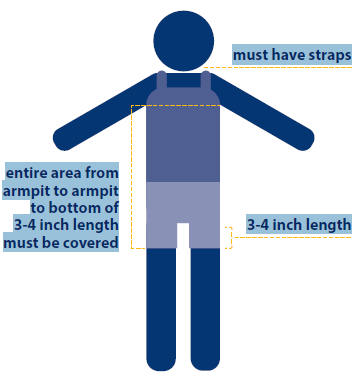
Students Must:
- Wear clothing that is opaque (non-see-through) with enough material to adequately cover the genitals, buttocks, nipples, rib cage, and midsection from the ribs to the hips.
- Be safe and suitable for the educational environment.
- Fall within the requirements of Diagram A and may not be sheer or see-through.
- Not promote and/or endorse the use of alcohol, tobacco, or illegal drugs, and/or encourage illegal, hate symbols, or violent activities.
- Do not display profanity, vulgar language, including but not limited to negative comments based on race, ethnicity, gender identity, or sexual orientation, or contain obscene gestures toward others.
- Not depict pornography, nudity, or sexual acts.
Guidelines for all students, school staff, teachers, and administrators:
- Each building principal or their designee shall be responsible for informing all students and their parents/ guardians of the student dress code at the beginning of the school year and any revisions to the dress code made during the school year.
- If a student’s clothing is in violation of the dress code, they will be required to modify their appearance to gain compliance with the dress code policy. Modification can include: covering or removing the offending item, and if necessary or practical, replacing it with an acceptable item.
- Any student who repeatedly fails to comply with the dress code shall be subject to further discipline.
- When staff or administration address a grooming or dress code violation, they should present options for obtaining appropriate clothing (ex., School clothing closet).
- Mayfield Central School District reserves the right to revisit and make modifications to the dress code policy if necessary.
Drug and Alcohol Abuse Policy
See the appendix for the district’s Drug and Alcohol Abuse Policy.
Technology Use Policy
Chromebook 1:1 Anytime, Anywhere Learning
Mayfield Central School District students in grades K-12 are assigned school-owned Chromebooks for use at school, as well as at home. Chromebooks have been used extensively in Mayfield Central School District for several years since we became a Google Workspace for Education district.
Chromebooks with Google Workspace (formerly known as G Suite) provide students with reliable and safe access to online resources and productivity tools. The educational version of Google Workspace allows the district to create a closed environment with settings to protect students while giving them access to vetted online educational tools and resources. Making these resources available 24/7 allows for anytime, anywhere learning and encourages students to become responsible consumers and creators of information.
The Chromebook 1:1 Anytime, Anywhere Learning Facilitates:
- Access to digital educational resources
- Availability beyond the school day
- Individualized learning
- Creativity and innovation
- Critical thinking and problem solving
- Communication and collaboration
- Technology literacy skills
- College and career readiness
The policies, procedures, and information in this document apply to all Chromebooks associated with the 1:1 program. Teachers may set additional requirements for technology use within their respective classrooms.
Chromebook Procedures and Agreement
1: Receiving/Returning Your Chromebook
1.1: Receiving Your Chromebook (Students new to Mayfield Central School District)
- Chromebooks will be distributed to new students after the following is completed: Parents and students must agree to the Mayfield Central School District Technology Use Policy.
1.2: Returning Your Chromebook
- Students who withdraw, are expelled, or terminate enrollment in Mayfield Central School District for any reason must return their individual Chromebooks on the date of termination to the main office.
Mayfield Central School District reserves the right to report failure to return the Chromebook to the appropriate authorities.
2: Taking care of your Chromebook
- If a student’s Chromebook is broken or fails to work properly, they should notify their teacher immediately. The teacher will contact the main office so that a loaner may be procured.
- If a student’s Chromebook is accidentally damaged, stolen, or malfunctions, the student should notify the school within 24 hours of the incident. Parents/ Guardians and/or students will be monetarily responsible for any damages, accidental or otherwise, to the device and charger.
- If the Chromebook is stolen, a police report will be required that lists the Chromebook as stolen.
2.1: General Precautions
- No food or drink is allowed next to your Chromebook while it is in use.
- Cords, cables, and removable storage devices must be inserted carefully into the Chromebook.
- Only the AC adapter provided by the school is to be used for charging your Chromebook.
- Students should never carry their Chromebooks by the screen.
- The Chromebook must be closed with the screen facing the keyboard, with nothing stored between them.
- Chromebooks should be shut down before storing them in order to conserve battery life.
- Chromebooks must never be left in an unlocked vehicle or any unsupervised area.
- Chromebooks must never be left in a vehicle where they could be subject to extreme heat or cold.
2.2: Carrying Chromebook
Parents/Guardians are advised to provide protective cases for use with the Chromebooks. They are meant to protect them and provide suitable means for carrying them within the school. The guidelines below should be followed:
- Chromebooks should always be in a protective case when carried.
- The Chromebook must be closed before placing it in the carrying case (See Sec. 2.1). No items are to be stored inside the Chromebook case with the Chromebook.
2.3: Screen Care
Chromebook screens can be damaged if subjected to rough treatment. They are particularly sensitive to damage from putting pressure and weight on the screen.
- Do not lean on the top of the Chromebook when it is closed.
- Do not place any materials on top of the screen when the Chromebook is closed.
- Always store the Chromebook with the screen facing the keyboard.
- Do not place anything on the keyboard before closing the lid (e.g., pens, pencils, or ear buds).
Clean the screen with a soft, dry cloth or anti-static cloth. Avoid using liquid of any kind on the screen unless the screen is soiled. If a liquid cleaner is required, apply a small amount of diluted rubbing alcohol to a lint-free cloth and carefully wipe the screen. Allow time for the screen to dry prior to closing the lid.
3: Using Your District-Issued Chromebook at School
School-issued Chromebooks are intended for use at school each day. Students are responsible for bringing their charged Chromebook to all classes, unless specifically instructed not to do so by their teacher(s). Teachers determine when and how the Chromebooks are to be utilized in the classroom.
3.1: Chromebooks Left at Home
- If a student does not bring his/her Chromebook to school, the student may visit the main office or library prior to the start of their first class and check out a loaner for the day. Students will not be excused from class to check out a loaner.
- If necessary, the main office will document the number of times a loaner is issued to each student for not having his/her Chromebook at school and will send a report to the principal for possible disciplinary action and/or the possibility of a parent/guardian being contacted to bring the Chromebook into school.
- Students who obtain a daily loaner will be responsible for returning the borrowed device to the main office by a designated time on the day the loaner was checked out. If it is not turned in by the designated time, the main office will take action to retrieve the daily loaner and pursue possible disciplinary actions.
3.2: Chromebook Support & Repairs
- If technical support is required, the student is to notify a teacher or the main office. The IT department will work with staff to resolve the issue in a timely manner.
- Loaner or replacement Chromebooks may be issued to students in the event that a Chromebook needs repair.
3.3: Charging Your Chromebook’s Battery
Chromebooks must be brought to school each day fully charged. The average full charge of a Chromebook battery is 10 hours. Students need to charge their Chromebooks every night so they are prepared for the school day, similar to their personal items, like cellphones. At school, a very limited supply of extra chargers is available for use in classrooms.
3.4: Personalizing Your Chromebook
- Inappropriate media may not be used, such as an avatar, wallpaper, screensaver, etc.
- Chromebooks must remain free of any drawing, stickers, or permanent writing. All asset tags must remain intact on the Chromebooks and their accessories (See Sec. 7.1).
3.5: Sound, music, Games, or Programs
- Sound must be muted at all times unless permission is obtained from the teacher for instructional purposes.
- Students may add appropriate music, photos, and videos to their Chromebooks. Personalized media are subject to inspection and must follow the Acceptable Use Policy.
- Internet/Computer Games that are not teacher-assigned or part of classwork are not to be used.3.6 Home Internet Access
- Students are allowed to connect to wireless networks on their Chromebooks.
- It is the responsibility of the parent/guardian to monitor their student’s internet access and behaviors at home.
Steps to Connect to Home WiFi:
- Turn on your Chromebook.
- At the login screen, click on the WiFi icon in the far bottom right corner of the screen.
- In the pop-up, click where it says “Not Connected” and select the name of your wireless network.
- If your wireless network requires a password, another window will pop up, prompting for the password.
- Enter the password, and your Chromebook will now be connected.
- You may now log in to your Chromebook with your school account.
4: Managing Your Files, Saving, & Printing Your Work
4.1: Saving Documents
- When online, documents are automatically saved and backed up in Drive as they are created and updated.
- When offline: any data stored locally on the Chromebook will NOT be backed up until an internet connection is established and Google Drive has been synced (see Sec. 4.3).
4.2: Saving Data to Removable Storage Devices
- Students are encouraged to back up their work using removable file storage. Removable memory sticks are not provided by the district.
- It is the student’s responsibility to ensure that work is not lost due to computer failure or accidental deletion.
4.3: Network Connectivity
- Mayfield Central School District makes no guarantee that its network will be up and running 100% of the time. In the rare case that the network is down, the school will not be responsible for lost or missing data.
- Most of the Google Drive Apps can be used offline. Once a student reconnects to the Internet, the offline files will sync with the Google Drive Account.
4.4: Printing Documents
- At School: Printing functionality is not available for student Chromebooks, as teachers are encouraged to assign and collect all work digitally. In the rare event that something needs to be printed, the student should ask their teacher.
- At Home: Chromebooks currently have limited support for a physical printer connection. Connecting your printer via USB cable to the Chromebook may or may not work depending on the printer model. Instead, it is recommended that students use their Google account on a home computer to retrieve a document for printing.
5: Software on Chromebooks
5.1: Originally Installed Software
The software originally installed by Mayfield Central School District must remain on the Chromebook in usable condition and be easily accessible at all times.
5.2: Virus Protection
Virus protection is unnecessary on the Chromebook due to the unique nature of its built-in security. Each web page and application runs in a restricted environment; therefore, visiting a web page that is infected with something malicious should not affect anything else on your Chromebook.
5.3: Additional Apps and Extensions
Students are only allowed to load appropriate applications and extensions listed in the “for Mayfield Central School District” section of the Chrome Web Store.
5.4: Expectation of Privacy
Students may be selected at random to provide their Chromebooks for inspection. The district reserves the right to monitor all Chromebook and Internet activity by students. As stated in the Acceptable Use Policy, students have no expectation of privacy in the use of district Chromebooks, including email, stored files, and Internet activity, either at school or away from school.
6: Responsible Use
Mayfield Central School District is pleased to be able to offer devices that provide the necessary applications required by classes, including access to email, student data storage, and the Internet. These devices are meant for educational purposes and are to be used only by the student to whom it was issued.
While these materials are provided to enhance educational goals and objectives, students may find ways to access other materials that may not be considered educational or find ways to use the provided hardware and software beyond their educational intent. For this reason, it is extremely important that rules are followed. Violations may result in disciplinary action up to and including suspension/expulsion of students. When applicable, law enforcement will be involved.
6.1: Parent/Guardian Responsibilities
- Talk to your student about digital citizenship and the standards they should follow on the use of the Internet, just as you do on the use of all media information sources, such as television, telephones, movies, and radio.
- Be an active participant in your student’s digital life. Have them show you what sites they are navigating, which apps they use, and what they are working on.
6.2: School Responsibilities
- Provide Internet and email access to students.
- Provide Internet filtering while at school. No filtering system will block 100% of material that may be deemed inappropriate. In some instances, what an individual may deem appropriate may be blocked incorrectly, and in other instances, what an individual may deem inappropriate may not be blocked.
- Provide network and/or cloud data storage areas. Mayfield Central School District reserves the right to review and restrict information stored on or transmitted via owned equipment and to investigate inappropriate use of resources.
- Provide staff guidance to aid students in doing research and ensure student compliance with the Acceptable Use Policy.
6.3: Student Responsibilities
- Use Chromebooks in a responsible and ethical manner as described in this document.
- Obey general school rules concerning behavior and communication that apply to computer use.
- Use all technology resources in an appropriate manner so as not to damage school equipment.
- Assist Mayfield Central School District in protecting our devices and network by contacting a teacher or an administrator about any security problems they may encounter.
- Monitor all activity on their account(s).
- Log off their device after they are done working to protect their accounts and files. If a student does not log off, any email or Internet activity under their name will be considered their responsibility.
- Contact a teacher or an administrator if he/she should receive an email containing inappropriate or abusive language or if the subject matter is questionable.
- Adhere to the terms of the district’s Technology Use Policy.
7: Protecting & Storing Your Chromebook
7.1: Chromebook Identification
Student Chromebooks will be labeled in the manner specified by the district. Chromebooks can be identified in the following ways:
- Serial Number
- Student ID
- Asset Tag: All Chromebooks will be labeled with a district Asset Tag. Asset Tags are not to be modified or tampered with in any way. If the asset tag falls off, please notify your teacher so that they may contact the IT department for a replacement tag.
7.2: Password Protection
Students are expected to use their account username and password and keep that password confidential. If a student fails to keep this confidentiality agreement and any part of the procedures described herein, have not been followed, appropriate disciplinary steps will be taken. It is the student’s responsibility to log off their school account; therefore, all emails or Internet activity under their name will be considered their responsibility.
7.3: Storing Your Chromebook
When students are not using their Chromebooks, they should be stored properly in the case with no other objects. Nothing should be placed on top of the Chromebook when stored in a school locker or backpack. Students are expected to take their Chromebooks home each day after school to ensure they are fully charged for the next day.
7.4: Chromebooks Left in Unsupervised Areas
Under no circumstances should Chromebooks be left in unsupervised areas. Unsupervised areas include:
- School grounds, cafeteria, computer labs, locker rooms, unlocked classrooms, and hallways.
- Any Chromebooks left in these areas are in danger of being stolen.
NOTE: If this becomes a pervasive issue, additional consequences may be applied.
8: Repairing or Replacing Your Chromebook
8.1: Damage
- Chromebooks that stop functioning due to defects will be covered by the district. The device will be repaired or replaced for the student at the district’s discretion.
- Repairs due to defects in materials and workmanship under normal use and not physical damage include, but are not limited to:
- The battery not holding a charge
- Device will not turn on/boot or start the operating system
- Screen will not illuminate
- Trackpad or Keyboard not working
8.2: Exclusions
Mayfield Central School District reserves the right to charge the student for repairs or the entire replacement cost if student negligence or accidental damage is determined to be the cause of disrepair.
This can include, but is not limited to:
- Not informing their teacher immediately of the damage to the device.
- Damage caused by failure to provide adequate protection for the device.
- Intentional damage to the Chromebook is also subject to disciplinary action.
- Inappropriate electrical use by using an inappropriate charger.
- Dishonest, fraudulent, or criminal acts.
- Dropping/Hitting/Accidental Impact of the device.
- Theft not accompanied by a police report.
- In the event that there are repeated accidents of a similar nature, the district may view this as a situation whereby the student did not exercise proper care and/ or reasonable precautions, and other instructional arrangements will be made.
There is NO INITIAL COST TO FAMILIES FOR THE CHROMEBOOK. Students, however, are responsible for the care of their Chromebooks and all related accessories. Parents agree to pay the cost for the repair or replacement of the device.
The most common parts and their approximate costs (as of 2024) are:
- LCD Screen: $75
- AC Adapter/Charger: $50
- Keyboard/Palmrest: $100
- Full Chromebook Replacement: $300
Current market prices fluctuate, and these estimates are subject to change.
8.3: Claim Procedures
- Report directly to the student’s classroom teacher with the Chromebook.
- A designated staff member will examine the Chromebook to determine if the problem is related to a defect or damage caused by the student.
- Students will be issued a loaner that may be taken home if a defect is determined. If it is determined that the damage was caused by the student, they will have a Chromebook signed out to them on a daily basis for use at school only until repairs are paid for.
- In cases of theft or disappearance, a police report must accompany the claim before a replacement Chromebook can be issued. The police report must also directly cite the theft or disappearance and the circumstances surrounding the situation.
9: Chromebook Technical Support
The classroom teacher or main office will be the first point of contact for any problems with a Chromebook.
Other services provided include:
- Distribution of loaner/replacement Chromebooks.
- Lending of spare charger or peripheral device for use during the school day.
10: Use of Technology Resources
10.1: Regulations
The use of Mayfield Central School District resources is a privilege, not a right. The privilege of using technology resources provided by Mayfield Central School District is not transferable or extendible by students to people or groups outside the district and terminates when a student is no longer enrolled in Mayfield Central School District. These procedures are provided to make all users aware of the responsibilities associated with efficient, ethical, and lawful use of school technology resources. If a person violates any of the user terms and conditions named in these procedures or the district’s Technology Use Policy, privileges may be terminated, access to district technology resources may be denied, and the appropriate disciplinary action will be taken.
10.2: User Terms and Conditions
The use of Mayfield Central School District technology resources is subject to the following terms and conditions:
- The use of technology resources must be for educational and/or research purposes consistent with the mission, goals, and objectives of Mayfield Central School District, along with State & Federal regulations. In compliance with federal law, the school district shall make reasonable effort to restrict access to inappropriate materials and shall monitor online activities of end users in the school environment.
- User accounts are considered property of the school district. Network administrators may review district computers to maintain system integrity and to ensure users are using the system responsibly. Students should not expect that anything stored on district computers or networks will be private.
- The district reserves the right to utilize our management service in order to provide the location of a lost or stolen Chromebook.
- The district reserves the right to utilize Chromebook management tools for instructional purposes.
10.3: Computer Network Violations
- Attempting to log on to the Internet or network (servers, routers, switches, printers, firewalls) as a system administrator.
- Sending, accessing, uploading, downloading, or distributing pornographic or sexually explicit materials.
- Installing, enabling, launching, or creating programs that interfere with the performance of the network, Internet, or hardware technology resources.
- Creating, uploading, or transmitting computer viruses.
- Attempting to defeat computer or network security.
- Use of the school’s Internet/email accounts for any illegal activity.
10.4: Infractions of any conditions included in this Procedures and Information handbook may result in the following consequences:
- Violation 1: Student will lose Chromebook privileges for the remainder of the day and will have to pick up his/her Chromebook in the office.
- Violation 2*: Student will have to turn in his/her Chromebook to the office. The parent/guardian will be responsible for picking up the Chromebook.
- Violation 3*: Student will have to turn his/her Chromebook into the main office for the remainder of the school year. A Chromebook will be made available for student use during the school day.
*Additional disciplinary consequences may vary depending on the severity of the offense, including referral to law enforcement authorities, and possible long-term suspension or recommended expulsion from school.
11: Mayfield central School district Student Pledge for Chromebook use:
- I will take good care of my Chromebook.
- I will never leave my Chromebook unattended in an unsupervised or unsecure location.
- I will never loan my Chromebook to other individuals.
- I will know where my Chromebook is at all times.
- I will bring my Chromebook fully charged to school daily.
- I will keep food and beverages away from my Chromebook since they may cause damage to the computer.
- I will not disassemble any part of my Chromebook or attempt any repairs.
- I will protect my Chromebook by only carrying it while stored properly in the case provided.
- I will use my Chromebook in ways that are appropriate and educational.
- I will use my Chromebook as directed by my teacher, the same like any technology.
- I will not place decorations (such as stickers, markers, etc.) on the Mayfield Central School District Chromebook. I will not deface the asset tag or serial number Chromebook sticker on any Chromebook.
- I understand that my Chromebook is subject to inspection at any time without notice and remains the property of the Mayfield Central School District.
- I will follow the policies outlined in this document and the district’s Acceptable Use Policy.
- I will report any operational problems or damages to the student help desk as they occur.
- I will file a police report in case of theft, vandalism, and other necessary acts.
- I will be responsible for all damage or loss caused by neglect or abuse.
- I agree to pay for the replacement items in accordance with the above document in the event any of these items are lost or stolen.
- I agree to return the Mayfield Central School District’s Chromebook and charger in clean, good working condition.
12: Distribution of Chromebooks
- Upon initial entry into the district, students will receive a Chromebook within the first weeks of instruction.
- Students enrolling in the district after the first date of school will be given their Chromebook during their orientation meeting.
- Parents and students are expected to read the entirety of this document, sign the Chromebook Student Use Contract, and return it to their classroom teacher or main office.
Mayfield Central School District Technology and Acceptable Use Policy and Procedures
- Mayfield Central School District 1:1 Chromebook Program Policies & Procedures
- Mayfield Central School District Chromebook Student Use Contract
- Mayfield Central School District Personal Device Policy and Contract
Restorative Practices
“The aim of all restorative interventions and student support services is to nurture students’ healthy development and resiliency; develop and strengthen behaviors and mindsets that will improve students’ academic, personal, and social efficacy; and enable all students to be successful in school and the classroom.”
(Lieber, Tissiere, Frazier. (2015) Shifting Gears: Recalibrating Schoolwide Discipline and Student Support)
Student discipline, policies, and practices must be implemented in ways that are accountable and restorative. Students and families need to know that the school will provide interventions inside and outside the classroom that support a restorative, rather than punitive, response. These interventions require students to own the problem, reflect on the impact of their behavior on themselves and others, and understand why the behavior was unacceptable or inappropriate.
We need to be aware that the person whose actions we are attempting to correct shall be in a place where they admit they were wrong, and they want to make amends or alter their behavior.
Restorative practices and the use of affective statements are practices on the continuum that can lead to restorative justice for larger offenses, usually involving long-term suspension or involvement with law enforcement.
Restorative Practices are interventions designed to hold students accountable for harm while addressing the needs of students, staff, and the school community. Restorative practice may be defined as a way of thinking and responding to conflict and problems, and one that includes all participants. Collectively, they determine a logical and balanced resolution.
School officials refer to this Code of Conduct, Character, and Support when determining which intervention and/or consequence to consider while ensuring the well-being of everyone involved. Practices that allow educators to address behavioral concerns as opportunities for learning instead of punishment are far more successful in changing a student’s behavior than imposing punitive measures. In determining how to best address inappropriate, unacceptable, and unsafe behaviors, it is necessary to evaluate all of the circumstances surrounding the behavior. There are many factors that will be considered before determining interventions and/or consequences, including:
- The student’s age and health.
- The student’s disciplinary record.
- Appropriateness of student’s academic placement.
- Interventions and/or consequences applied in response to prior behavior violations.
- Nature, severity, and scope of the behavior.
- The circumstances in which the conduct occurred.
- Students’ understanding of the impact of behavior.
- Seriousness of the behavior and the degree of harm caused.
- Impact on overall school community.
- The student’s Individualized Education Plan (IEP), Behavior Support Plan, Behavioral Intervention Plan (BIP), and 504 Accommodation Plan, when applicable.
- The student’s response to intervention.
Restorative Interventions
Interventions are the logical follow-through step when a student experiences repeated difficulty after promotion and prevention (Tier 1) strategies have been implemented, and when student behaviors have an adverse impact on the student and the classroom.
For some students, interventions are implemented when behaviors become chronic and repeatedly occur over a period of days or a week or two without observable change. Students will more willingly enter and participate in the restorative intervention process when they understand that predictable consequences and interventions are part of the natural learning cycle in the classroom.
It is important to establish thresholds or red flags that prompt required interventions, so that adults’ readiness to intervene is front and center and lets students know in advance what will be required of them when setbacks are noticed.
Restorative Interventions are part of a natural cycle of learning and self-correction. Helping children and young people navigate academic, social, and emotional challenges successfully is a shared obligation of parents/caregivers and school staff. Interventions are normalized by discussing “What will happen when….” with students in advance, so they are able to enter the process of restorative intervention with goodwill and less resistance.
The complexity and length of an intervention depend on the type and frequency of incidents and issues with which a student is struggling.
- Interventions for Repeated Behavioral Violations address a specific behavior that has repeatedly occurred over a period of days or several weeks in classrooms or public spaces without an observable improvement. An intervention will be implemented, and progress will be monitored over a period of no less than six weeks.
- Interventions for Serious Behavior Violations require an immediate response to a specific behavior violation and often address incidents of fighting, bullying, or harassment, or incidents in which a student has seriously jeopardized safety and order in classrooms or public spaces. After the intervention is implemented, an MTSS (Multi-Tiered Systems of Support) team member will follow up with students to assess whether the desired outcomes of the intervention have been met.
- Comprehensive, Longer-Term Interventions are most appropriate when students have accumulated multiple referrals linked to multiple behavior violations or are experiencing multiple academic, behavioral, or attendance challenges, mental health concerns, and/or family crisis. Members of the MTSS team are likely to make an initial assessment of a student’s situation. Then an MTSS team member will meet with the student and family to explore root causes of concerns and create an Intervention Plan that will be implemented and monitored over a minimum of six weeks.
Behavioral and Academic Interventions
Restorative interventions provide the structure in which we listen and speak responsively. Restorative interventions range from informal one-to-one conferences to more formal processes like mediation, parent/caregiver and restorative group conferences, and a school re-entry conference.
The following list sets up a scope of possible interventions, but is not all-inclusive. Individualized interventions will be determined by relevant staff in the school and based on the individual student’s circumstances.
- Academic Problem-Solving and Planning Conference: Offers students an opportunity to reflect on a series of questions, identify action steps that will help them learn a target behavior and be more successful, and agree on how to monitor progress (includes follow-up call with a parent/caregiver).
- Academic Coaching: These sessions provide time for individuals or small groups to engage in intensive practice of a specific target behavior or skill; to engage in guided study time to prepare for assessments; to complete, revise, or correct important work; or to re-learn or begin to learn a skill required to complete current learning tasks.
- Academic Turnaround Conference: Meeting with a student or groups of students through a structured conference intended to interrupt a persistent pattern of academic slippage and help students identify target behaviors or academic skills that will help them improve their grade by the end of the marking period.
- Behavior Problem-Solving and Planning Conference: This focuses on a single discrete behavior that needs to be replaced to support the student academically, socially, and emotionally. This is a powerful way to communicate care and concern, as well as to increase the student’s capacity to reflect and problem solve.
- Bullying and Harassment Protocol: A set of consistent protocols to address harm created by an incident of bullying and harassment to restore emotional and/or physical safety and rebuild damaged relationships.
- Mediation (Student-Student): A protocol to use when students are involved in a protracted interpersonal conflict or have been involved in a physical or verbal fight in which neither party has engaged in an unprovoked attack. Perspective taking is a critical component of this protocol.
- Mediation (Teacher-Student): Intended for teacher-student conflicts. The goal of mediation is to work out differences constructively in a way that solves the problem and preserves the relationship.
- Parent/Caregiver Conference: A structured, three-part protocol used to communicate with parents/caregivers when in-class strategies to address academic slippage or persistent behavior concerns have not led to improved student outcomes. The intention is to ensure that student and parent/caregiver voice is part of the conference and problem-solving process.
- Re-entry Procedure: A protocol implemented when a student is returning from a temporary removal from school. The student has an advocate in the room to support the conversation and re-entry plan.
- Restorative Conversations: A discussion led by an adult using a set of restorative questions. This intervention is an effective way to address situations when one student behaves in a way that directly harms an individual or the group, or when two or more students are involved in an interpersonal conflict. RC helps students take responsibility for what happened, reflect on the impact of the incident on others, and arrive at a solution that mends relationships and helps to leave the past behind and move ahead.
- Restorative Community Circle: Circles build trust, psychological safety, and class cohesiveness by engaging students in a real dialogue about real issues, encouraging honesty, deep listening, and the sharing and holding of each person’s perspective. They create the space for groups to respond proactively to challenges or harms.
- Restorative Group Conference: This protocol is used for high-impact incidents that have seriously harmed or threatened the safety and well-being of individuals and groups or the safety, functioning, and reputation of the school community.
- In cases where the disciplinary situation is more complicated and/or with students who present complex needs, it is recommended that administrators consult with key school staff who possess knowledge of the student and can offer insights and information before making final decisions.
In practice, this means that…
- Accountable consequences intensify as behavior violations become more serious. Also, multiple violations for the same behavior may warrant more intensive consequences at a higher level.
- All interventions must be accessible to each student.
- Consequences and interventions are delivered using standardized procedures, protocols, or processes and are consistently applied across all groups of students in all schools.
- A transparent data set, determined by district leaders and school leaders, will be collected and analyzed consistently to assess the use and impact of consequences and interventions, paying particular attention to indicators of overuse and disproportionality of referrals and suspensions among various student groups.
- When an exclusionary response is warranted, the focus will be on short-term removals from the classroom and fewer assigned days to in-school suspension and out-of-school suspension. In the majority of situations, students will be referred to the RISE (Restorative In-School Suspension Education) Program for skill development and restorative interventions.
Promotion, Prevention, and Intervention
Mayfield Central School District has identified a set of strategies and practices to be utilized by district staff in order to support students to engage in skilled, appropriate, and acceptable behavior that encourages learning.
Promotion is defined as strategies that promote positive behavior, academic, and social/emotional development. These strategies are identified within classroom management and classroom instruction, as well as from the school-wide building expectations and established rules and procedures.
Prevention strategies prevent off-track behaviors from becoming major problems. These strategies are through classroom discipline and school-wide efforts to promote effective ways to target behavior.
Intervention protocols match a student’s academic, social, and emotional needs and support them in becoming more skillful. Staff provide interventions that match academic, social, and emotional needs for students who are experiencing persistent challenges and support the students to learn more skillful behaviors.
Levels of Behaviors and Responses
The Mayfield Central School District understands the importance of restorative practices when student behavioral issues affect the safety of the classroom and school and interfere with the learning of all students. When choosing interventions and consequences for student behavior, teachers, administrators, and all staff will balance Mayfield’s goals of ensuring equity, minimizing disruptions, and maximizing student instructional time. Consequences paired with meaningful instruction and guidance (corrective feedback and reteaching) offer students an opportunity to learn from their mistakes.
Progressive Discipline
Understanding consequences as “teachable moments” is fundamental to a positive approach to discipline. Instead of seeking punishment, progressive consequences seek to ensure accountability and behavior change.
With progressive consequences, a student’s first violation will usually merit a lower-level consequence than subsequent violations. A variety of factors, however, are considered before determining the consequence. In instances where a student’s conduct is dangerous or threatens the safety of others, more severe disciplinary action may be warranted, even if it is the student’s first violation.
With progressive consequences, we aim to help students:
- Understand why the behavior is unacceptable.
- Understand the harm the behavior caused and the impact that it has.
- Take responsibility for their action.
- They should be given the opportunity to repair the harm caused by their behavior.
- Be given the opportunity to learn prosocial strategies and skills to use in the future.
Every reasonable effort should be made to correct student misbehavior through interventions and other school-based resources. It is imperative that school personnel be sensitive to any issues that may influence the behavior of students and respond in a manner that is most supportive of their needs.
Districtwide School Rules
Rules are a set of explicit, enforceable regulations that govern conduct, which refers to the way a person behaves on a particular occasion or in a particular context. Rules create a sense of order, calm, and purposefulness, and they promote a safe and positive learning environment. A rule can be broken. Naming something a rule comes with the obligation to enforce it consistently.
Schools are public places. When we gather in schools, we come to agreement about rules that help us navigate shared spaces. Supporting students to follow districtwide rules requires effort from each and every adult to promote, support, and enforce the rules.
Sharing an understanding of the rules and the interests behind them creates structure and clarity for all members of the school community. Rules that are fairly and consistently applied strengthen essential life skills such as self-management and social efficacy.
Districtwide rules promote consistent standards of behavior across all schools. The following four rules cover the most frequent behavior violations. More specific descriptions of behavior violations are found in the Behavior Violation and Consequence Matrix.
Rule: I arrive on time, stay in class, and have a pass/permission to travel in public spaces.
What it looks like: Enter the classroom before the bell rings (Secondary). Ask for a pass from an adult to travel in public spaces during class time or lunch.
Examples of rule violations:
- Skipping school or class
- Leaving school or the classroom without permission
- Unexcused late arrival to school
- Unexcused tardiness to class during the school day
Rule: I listen, acknowledge, and respond to directives and requests.
What it looks like: Follow instructions, procedures, and rules. Ask questions if confused. Accept help, feedback, correction, and direction with positive intent.
Examples of rule violations:
- Does not follow classroom procedures, practices, and routines
- Does not respond to directions
- Engages in argumentative, aggressive speech, back-talk, and hostile refusal
Rule: I stay safe and respect others’ personal space.
What it looks like: Walk calmly in public spaces. Keep your hands and body to yourself and respect personal space.
Examples of rule violations:
- Running, play fighting, yelling in public spaces/classrooms
- Unwanted physical touch or invasion of personal space
- Verbal and physical threats, physical aggression, and/or physical assault directed toward adults
- Verbal and physical threats, physical aggression, and/or physical assault directed toward students
Rule: I respect and value everyone’s individual and group identity.
What it looks like: Make an effort to understand others. Accept different viewpoints. Interrupt or call attention to incidents of prejudice or inequality.
Examples of rule violations:
- Harmful teasing and name-calling
- Making fun of someone maliciously, using a hostile tone with deliberate intent to annoy, trigger anger or distress, belittle, embarrass, or hurt someone’s feelings
- Bullying
- Bias-related incidents, such as racial slurs, prejudicial actions, or hate speech
- Inappropriate sexual behavior, sexual harassment, and sexual assault
- Non-sexual harassment
The Disciplinary Response Cycle
When students violate a rule and their unskillful, inappropriate, or unacceptable behaviors require attention, care, and support beyond the responses of the classroom teacher, the Disciplinary Response Cycle (DRC) takes effect. It is a school-wide set of actions that involves four phases. The DRC is standardized to ensure fair, equitable, and respectful responses to students’ misbehaviors and provides a continuum of support throughout the process.
- Referral
- Accountable Consequences
- Restorative Interventions
- Closing the Loop
Mayfield Elementary School, Pre-K–6, Levels of Intervention and Behavior Violations
Mayfield Elementary has created a progressive behavior intervention process to identify the most documented challenging behaviors, restorative interventions, and possible consequences to be assigned, if needed. However, the process, including behaviors, interventions, and consequences, is an example or guide to be referred to. Mayfield Elementary recognizes that not all situations can be predicted. Therefore, the administration and staff have the autonomy to make decisions based on the specifics of each situation. Decisions will be made in the best interest of students, teachers, administrators, and the school community in general, and may not always align with the process below.
Behavioral Intervention Levels
Level 1
- Warning
- Conference with Student
- Timeout with Buddy Teacher
- Parent Contact from Teacher
Level 2
- Classroom Referral
- Reflection Sheet
- Classroom Reset, Reflect, Re-engage
- Minor Loss of Privileges
- Parent Contact from Teacher
- Parent/Student/Teacher Conference as Warranted
Level 3
- Office Referral
- Student Conference with Administration
- Loss of Privileges
- Reset, Reflect, Re-engage
- Restorative Intervention
- Referral to Counselor/RTI
- Parent Contact from Administrator
- Administrative Conference as Warranted
Level 4
- Office Referral
- Student Conference with Administration
- Loss of Privileges
- Reset, Reflect, Re-engage
- Restorative Intervention
- OSS Up to 5 Days
- Referral to Counselor/ RTI
- Parent Contact from Administrator
- Administrative Conference as Warranted
Level 5
- Referral to District Office
- Referral to Law Enforcement
LEVEL 1
Level 1 behaviors represent minor disruptions to the classroom environment.
Typically, they are not referred to an administrator until the classroom level interventions are not correcting the behavior. Minor level 1 behaviors are managed with learning opportunities for students to strive to make better choices. With level 1 behaviors, the goal is to correct the behavior while limiting the time missed from class. Staff should use responses in a graduated fashion.
LEVEL 2
Level 2 behaviors represent repeated minor disruptions to the classroom environment.
Level 2 behaviors are also classroom managed, but may involve administrative support as needed. Level 2 behaviors are managed with learning opportunities and reflective practices for students to strive to make better choices. With level 2 behaviors, the goal is also to correct the behavior while limiting the time missed from class. Staff should use a graduated fashion and seek administrative support for significant repeated minor disruptions to the classroom environment as warranted. Minor referrals need to be created for significant repeated minor disruptions to the classroom environment.
LEVEL 3
Level 3 behaviors represent acts whose frequency or seriousness disrupt the learning environment of the school.
These violations always result in the involvement of school administration. With Level 3 behaviors, the goal is to correct the behavior by stressing the seriousness of the offense while keeping the student in school. Staff should use responses in a graduated fashion. Major referrals need to be created for any level 3 behavioral incidents.
LEVEL 4
Level 4 behaviors represent acts against a person(s) or property that indirectly endanger the health or safety of others in the school or severely impact or disrupt the school environment.
Level 4 may also include repeated similar offenses. These offenses may result in the short-term removal of the student from the school environment and school-related activities because of the severe nature of the offense. Response options may include combinations of interventions, resolutions, and discipline. Major referrals need to be created for any level 4 behavioral incidents.
LEVEL 5
Level 5 behaviors represent acts against a person(s) or property that may directly or indirectly endanger the health or safety of others.
Level 5 discipline offenses represent the most serious acts of misconduct and must be immediately reported to the principal. These violations are so serious that they may require the use of outside agencies and/or law enforcement. Such acts may also result in criminal penalties being imposed. Any misconduct that threatens the health, safety, or well-being of others may result in immediate suspension of the student from the school and/or school-sponsored activities, pending disciplinary investigation of the allegations. Level 5 behavioral incidents will be referred to the superintendent, district leadership team, as well as appropriate law enforcement as warranted.
Classroom Managed
Level 1
- Inappropriate language
- Teasing
- Refusal to work
- Running in an inappropriate area or time
- Minor dishonesty
- Academic dishonesty
- Minor disruption
- Minor aggression – passing hits/shoving
- Unsafe or rough play
- Disrespect
- Tone
- Attitude
- Gestures
- Inappropriate use of materials
- Pattern of incomplete work
- Digital misuse
- Cell phone – 1st offense
Level 2
- Repeated inappropriate language
- Repeated teasing
- Repeated refusal to work
- Repeated running in an inappropriate area or time
- Repeated minor dishonesty
- Repeated academic dishonesty
- Repeated minor disruption
- Repeated minor aggression — passing hits/shoving
- Repeated unsafe or rough play
- Repeated disrespect
- Tone
- Attitude
- Gestures
- Repeated inappropriate use of materials
- Repeated pattern of incomplete work
- Repeated digital misuse
- Cell phone – 2nd offense
Administrative Managed
Level 3
- Property destruction
- Aggressive physical contact
- Pattern of aggressive/profane language
- Harassment of students/teachers
- Major/chronic disruption
- Major/chronic refusal to follow school rules
- Major dishonesty
- Cheating on major assessments
- Bullying
- Inappropriate display of affection
- Cell phone – 3rd offense
Level 4
- Leaving class without permission
- Fighting
- Leaving campus
- Major theft
- Vandalism/severe property destruction
- Creating a potentially unsafe environment
Level 5
- Weapons/drugs
- Credible threats
- Persistently dangerous actions
High School, 7-12, Levels of Intervention and Behavior Violations
Behavioral Intervention Levels
- Level 1 Consequences: Promotion/Prevention Responses Facilitated by Teacher
- Levels 2 and 3 Consequences: Interventions Facilitated by Teacher, Student Support, and/or Administration
- Levels 4 and 5 Consequences: Interventions Facilitated by Student Support and/or Administration
Level 1 Behavior Violation
Minor classroom and minor public space behavioral incidents
Action:
- No administrative send-outs: Student remains in the classroom.
- Possible teacher-led restorative conversations/interventions
- Use of Tier 1 Strategies (Depersonalization, Defusing Upset Students, Behavior Check-Ins).
- Loss of privileges (lunch detention, loss of recess, pass restriction, timeout in office – non-instructional time).
- A student support note is submitted when a student’s low-impact, unskillful behaviors raise concern and warrant documentation within the school’s student database.
- A student support note helps teachers share specific information/data that may reveal behavior patterns and trends that need to be addressed if these behaviors become chronic.
Level 1
- Behavior Violation: Minor classroom and minor public space behavioral incidents
- Action:
- No administrative send-outs – Student remains in classroom
- Possible teacher-led restorative conversations/interventions
- Use of Tier 1 Strategies (Depersonalization, Defusing Upset Students, Behavior Check-Ins)
- Loss of privileges (lunch detention, loss of recess, pass restriction, timeout in office – non-instructional time)
- A student support note is submitted when a student’s low-impact, unskillful behaviors raise concern and warrant documentation within the school’s student database
- A student support note helps teachers share specific information/data that may reveal behavior patterns and trends that need to be addressed if these behaviors become chronic
Level 2
- Behavior Violation: Persistent, low-impact classroom behavior violations, more serious public space violations, and non-violent personal misconduct
- Action:
- No administrative send outs – Student remains in classroom
- Possible Student Support Team referral, and/or referral or intervention by Counseling staff
- Discipline referral submission
- Teacher-managed discipline with possible administrative intervention
- Aligned consequence and intervention, including restorative intervention
- Continued use of Level 1 Actions – teacher remains involved
- Accumulation of referrals may prompt a Level 3 response
Level 3
- Behavior Violation: More serious behavior violations, as determined by their severity and frequency
- Action:
- Discipline referral submission + restorative intervention
- Student Support Team & Behavior Plan
- Send-out and possible .5–2 Day ISS/RISE OR up to 1 Day OSS
- Aligned consequence and intervention, including restorative intervention
- All secondary students with OSS return to school with at least .5 days in ISS/RISE for re-entry plan
- Continued use of Level 1 & 2 Actions
Level 4
- Behavior Violation: Repetitive or high-impact behavior violations that involve verbal and physical violence and violations that have a destructive or disruptive impact on the school community
- Action:
- Discipline referral submission + send out + restorative intervention + possible ISS/RISE for remainder of the day
- Send-out and possible .5–3 Days ISS/RISE OR up to 5 Days OSS
- ISS/RISE can be no more than 3 days
- Aligned consequence and intervention, including restorative intervention
- All students with OSS return to school with at least .5 days in ISS/RISE for re-entry plan (please see the appendix for explanation of plan)
- Students are required to meet with a school psychologist and/or social worker
- Referral to appropriate outside agency, counseling, or drug-treatment program, and SRO notification
Level 5
- Behavior Violation: Behaviors that present the most serious level of threat and harm to individuals and the school community
- Action:
- Discipline referral submission + send-out + restorative intervention
- Five or more days OSS
- Aligned consequence and intervention, including restorative intervention
- Restorative interventions should begin during the suspension and not wait for the student’s return to school
- All secondary students with OSS return to school with at least 1 full day in ISS/RISE for re-entry plan
- Referral to appropriate outside agency, counseling, or drug-treatment program, and SRO notification
- Superintendent hearing
Violation Category: Classroom, Bus Behavior Violations
Classroom Misbehavior
Description of the Offense:
- Lack of compliance with classroom routines and procedures; off-task behavior; interrupting others from doing their work; engages in demands, argumentative and adversarial speech, both orally and in writing, including chat in online learning platforms.
- Applicable Level(s): Level 1
Persistent Classroom Misbehavior
Description of the Offense:
- Continued lack of compliance with classroom routines and procedures; off-task behavior; interrupting others from doing their work; engages in demands, argumentative and adversarial speech, both orally and in writing, including chat in online learning platforms.
- Applicable Level(s): Level 2
School Bus Misbehavior
Description of the Offense:
- Not following bus safety expectations. This includes excessive noise, standing up while the bus is moving, changing seats, and throwing objects, and distraction of the driver while driving or otherwise behaving in a way to impact safety on the school bus.
- Applicable Level(s): Level 2
Academic Dishonesty
Description of the Offense:
- Includes plagiarism, cheating, copying from another student, book, or website, altering records, use of artificial intelligence for plagiarism, and assisting another student in any of the above actions. This includes violations individually or as part of a group.
- Applicable Level(s): Level 2, Level 3
Public Space Misbehavior
Description of the Offense:
- Running, excessive noise, horseplay, loitering, or unauthorized hall walking.
- Applicable Level(s): Level 1
Gambling, Betting, and/or Wagering
Description of the Offense:
- Gambling in any form that involves the exchange of monetary stakes on school grounds or school-sponsored events.
- Applicable Level(s): Level 1, Level 2
Dress Code Violation
Description of the Offense:
- Non-compliance with the district dress code policy.
- Applicable Level(s): Level 1, Level 2
Disruptive and Uncooperative Behavior
Description of the Offense:
- Lack of prompt, respectful compliance with directions or requests of any school staff member, including teachers, support personnel, secretaries, custodians, and/or bus drivers.
- Applicable Level(s): Level 1, Level 2, Level 3
Inappropriate Language or Expression
Description of the Offense:
- Swearing, cursing, or making obscene gestures not specifically at a person.
- Applicable Level(s): Level 1, Level 2
Violation Category: Classroom, Bus Behavior Violations
Forgery
Description of the Offense:
- Writing the name of another person to be represented as a writing or original signature of that other person or altering any written record or document (such as dates, times, passes, and permits).
- Applicable Level(s): Level 1, Level 2, Level 3, Level 4
Refusal to Identify
Description of the Offense:
- Refusing to identify oneself when asked by a member of the school staff, either an administrator or a teacher.
- Applicable Level(s): Level 1
Use of Racial Slurs
Description of the Offense:
- Use of racial slurs or protected class references directed towards another student or staff member — written or verbal expressions.
- Applicable Level(s): Level 2
General Theft
Description of the Offense:
- Taking or attempting to take money or property belonging to another person or the school with the intent to permanently deprive the victim of his or her possessions.
- Applicable Level(s): Level 3, Level 4
Failure to Respect Materials/Property of Others
Description of the Offense:
- Failure to respect materials or property and stealing from others (including, but not limited to, stealing and/or damage to cell phones, other electronic devices, and credit cards/debit cards).
- Applicable Level(s): Level 2, Level 3, Level 4
Violation of School Rules
Description of the Offense:
- This category comprises misbehavior not captured elsewhere. Problem behaviors could include violations that negatively affect the school.
- Applicable Level(s): Level 1, Level 2, Level 3
Inciting or Participating in a Disturbance
Description of the Offense:
- Engaging in an intentional act to disrupt the normal operation of the school community; instigating or encouraging another person to violate the Code of Conduct, Character, and Support.
- Applicable Level(s): Level 3, Level 4
Refusal to be Searched
Description of the Offense:
- Refusing to allow a search by a school official who possesses reasonable suspicion that a student may possess contraband, violating school policy that could potentially endanger the welfare of the student or the safety of others.
- Applicable Level(s): Level 3, Level 4
Violation Category: Classroom, Bus Behavior Violations
School Safety Violation
Description of the Offense:
- Circumventing school safety protocols, including opening secured exterior doors to permit access to another person.
- Trespassing in unauthorized or unsupervised areas of the building. This includes, but is not limited to, entering the classroom or building before or after school.
- Applicable Level(s): Level 3, Level 4
Skipping Class
Description of the Offense:
- Cutting class (never attending).
- Applicable Level(s): Level 1
Tardiness to Class
Description of the Offense:
- Lateness for class without permission.
- Applicable Level(s): Level 1
Elopement
Description of the Offense:
- A student is caught in an area of the school where they are not supposed to be during school hours.
- Applicable Level(s): Level 1, Level 2
Persistent or Frequent Skipping
Description of the Offense:
- Frequently cutting class (never attending).
- Applicable Level(s): Level 2, Level 3
Persistent Tardiness
Description of the Offense:
- Frequently late to class.
- Applicable Level(s): Level 2, Level 3
Leaving Class
Description of the Offense:
- Leaving class without permission (attended class, but left).
- Applicable Level(s): Level 2, Level 3
Leaving School
Description of the Offense:
- Leaving school without permission.
- Applicable Level(s): Level 2, Level 3
Other Attendance Policy Violation
Description of the Offense:
- An incident that cannot be coded in one of the above categories but did involve an attendance policy violation – this could include, but is not limited to, after-school detention and 9th period.
- Applicable Level(s): Level 2, Level 3
Physical Aggression
Description of the Offense:
- Confrontation or physical aggression that does not result in injury.
- Applicable Level(s): Level 3
Aggressive Non-Compliant Speech
Description of the Offense:
- Hostile, oppositional, confrontational refusal to comply with reasonable directives and requests by authority.
- Applicable Level(s): Level 2, Level 3
Aggressive Language
Description of the Offense:
- Cursing, swearing, use of insulting, defaming, vulgar, or abusive language directed at a student or adult.
- Applicable Level(s): Level 2, Level 3
Violation Category: Classroom, Bus Behavior Violations
Physical Threat
Description of the Offense:
- Threatening an individual or group of individuals with a gesture(s) or body language. Includes posturing.
- Applicable Level(s): Level 1, Level 2, Level 3
Verbal Threat
Description of the Offense:
- Threatening an individual or group with spoken words or sounds or physical gestures. The intensity of the threat needs to be considered.
- Applicable Level(s): Level 1, Level 2, Level 3
Written Threat
Description of the Offense:
- Threatening an individual or group in writing (letter, note, message, chat). The intensity of the threat needs to be considered.
- Applicable Level(s): Level 1, Level 2, Level 3
Electronic Threat
Description of the Offense:
- Threatening an individual or group by text, email, or social media post. The intensity of the threat needs to be considered.
- Applicable Level(s): Level 1, Level 2, Level 3
Fighting
Description of the Offense:
- Mutual participation in an altercation involving physical violence, where injury may have occurred.
- Applicable Level(s): Level 2, Level 3, Level 4, Level 5
Battery (Physical Attack)
Description of the Offense:
- Touching or striking a person or intentionally causing bodily harm to an individual. This includes hitting, kicking, shoving, punching, or scratching.
- Applicable Level(s): Level 4, Level 5
Electronic Use Violation
Description of the Offense:
- Use of district-provided technology for non-educational purposes; intentionally circumventing the management and content filtering that is applied to district-provided devices.
- Applicable Level(s): Level 1, Level 2, Level 3
Cell Phone Violation
Description of the Offense:
- Use of personal cell phone or any non-educationally required device, electronic or otherwise, that detracts from and/or generally disrupts learning is prohibited.
- Applicable Level(s): Level 1, Level 2, Level 3, Level 4
Recording
Description of the Offense:
- Recordings/images of another person(s).
- Applicable Level(s): Level 1, Level 2, Level 3, Level 4
Distribution of Recording of a Physical Altercation
Description of the Offense:
- Making, transmitting, or distributing, including posting to the internet, any recording of physical contact, voice/image of any other student, staff, or other person.
- Applicable Level(s): Level 1, Level 2, Level 3, Level 4
Cyberbullying
Description of the Offense:
- Intentional use of technology to bully, harass, threaten, embarrass, discriminate, or target another person.
- Applicable Level(s): Level 2, Level 3, Level 4, Level 5
Violation Category: Harassment and Bullying
Allegation of Bullying
Description of the Offense:
- Staff member witnesses or has reported to them a possible instance of bullying.
- Applicable Level(s): Level 1
Bullying
Description of the Offense:
- The repeated use by one or more students (aggressors) of a written, verbal, or electronic expression or a physical act or gesture of any combination thereof, directed at a target that:
- causes physical or emotional harm to the target or damage to the target’s property;
- places the target in reasonable fear of harm to him/herself or of damage to his/her property;
- creates a hostile environment at school for the target;
- infringes on the rights of the target at school;
- materially and substantially disrupts the education process or the orderly operation of a school.
- Applicable Level(s): Level 3
Other Nonsexual Harassment
Description of the Offense:
- The incident cannot be coded in one of the above categories, but did involve nonsexual harassment.
- Applicable Level(s): Level 2
Hazing
Description of the Offense:
- Committing an act or acts against a student or coercing a student to commit an act that creates risk of harm to a person in order to be initiated into a student organization or class.
- Applicable Level(s): Level 4
Violation Category: Vandalism (Damage to Personal or School Property)
Vandalism of School Property
Description of the Offense:
- Intentionally damaging or destroying school property. The frequency and severity of the incident need to be considered when assigning levels. May require some form of restitution.
- Applicable Level(s): Level 2, Level 3, Level 4
Vandalism of Personal Property
Description of the Offense:
- Intentionally damaging or destroying the personal property of a student or staff member, including graffiti. The frequency and severity of the incident need to be considered when assigning levels. May require some form of restitution.
- Applicable Level(s): Level 1, Level 2, Level 3, Level 4
Violation Category: Sexual Misconduct and Obscene Behavior
Displays of Affection
Description of the Offense:
- Inappropriate physical displays of affection, including holding hands, kissing, sexual touching, or other displays of affection in school or at a school event.
- Applicable Level(s): Level 1, Level 2, Level 3
Non-Consensual Sexual Acts
Description of the Offense:
- Intentionally revealing or exposing one’s genitals, buttocks, breasts, or any other private parts of their naked body.
- Applicable Level(s): Level 1, Level 2
Obscene Written Messages and/or Obscene Pictures
Description of the Offense:
- Writing obscene messages on paper, blackboards, or elsewhere on school property (e.g., bathroom walls), or creating illustrations of a sexually explicit or vulgar nature.
- Applicable Level(s): Level 2, Level 3
Obscene Gestures and Language
Description of the Offense:
- Gestures that are offensive, socially unacceptable, or otherwise not suitable for an educational setting, and/or suggestive, explicit, or vulgar language, cursing, or abusive language.
- Applicable Level(s): Level 2, Level 3
Possession of Pornography
Description of the Offense:
- Possessing, making, or observing pornographic material or partially nude state, regardless of consent.
- Applicable Level(s): Level 1, Level 2, Level 3, Level 4
Obscene Electronic Communication
Description of the Offense:
- Posting obscene messages on internet message boards, sending obscenities via internet chat rooms/instant messaging, Twitter, or other social media, cell phone text, and downloading, saving, or emailing obscene material.
- Applicable Level(s): Level 2, Level 3
Consensual Sexual Activity
Description of the Offense:
- Engaging in sexual intercourse, physically displaying one’s buttocks, breasts, or genitals, or removing/adjusting the clothing of another person to expose undergarments or private parts.
- Applicable Level(s): Level 2, Level 3
Non-Consensual Touching
Description of the Offense:
- Non-consensual touching of a person’s back, shoulder, hand, buttocks, breasts, genitals/private areas, or any other body parts deemed unwelcome by the person.
- Applicable Level(s): Level 2, Level 3, Level 4
Distribution of Pornography
Description of the Offense:
- Transmitting or disclosing any image of a student, minor, staff member, parent, school volunteer, or other adult with supervisory authority in a nude state, regardless of consent.
- Applicable Level(s): Level 3, Level 4, Level 5
Non-Consensual Sexual Activity
Description of the Offense:
- Engaging in non-consensual sexual intercourse, including oral sex.
- Applicable Level(s): Level 4, Level 5
Sexual Harassment
Description of the Offense:
- Unwelcome sexual advances, requests for sexual favors, other physical or verbal conduct/communication of a sexual nature, including gender-based harassment that creates an intimidating, hostile, or offensive environment.
- Applicable Level(s): Level 4, Level 5
Violation Category: Alcohol, Drugs, and Tobacco
Possession/Distribution of Tobacco Product
Description of the Offense:
- In possession of and/or distributing any tobacco product, vaping device, or other nicotine inhaler (e.g., vape device, e-cigarette).
- Applicable Level(s): Level 2, Level 3
Possession/Distribution of Alcohol
Description of the Offense:
- In possession of and/or distributing any beverage or substance containing alcohol.
- Applicable Level(s): Level 2, Level 3, Level 4
Possession/Distribution of Marijuana Product
Description of the Offense:
- In possession of and/or distributing marijuana, products containing THC, Delta 9,10, etc., or any drug other than marijuana (including paraphernalia).
- Applicable Level(s): Level 2, Level 3, Level 4
Possession/Distribution of Prescription Medicine
Description of the Offense:
- In possession of and/or distributing prescription or over-the-counter medicine in violation of school rules.
- Applicable Level(s): Level 2, Level 3, Level 4
Possession/Distribution of Illegal Drugs
Description of the Offense:
- In possession of and/or distributing illegal drugs on school grounds or at school events.
- Applicable Level(s): Level 2, Level 3, Level 4
Suspicion of Use of Tobacco, Alcohol, Marijuana, or Illegal Drug
Description of the Offense:
- An instance where an individual’s behavior, breath, or physical presentation suggests that they have used tobacco, alcohol, or marijuana.
- Applicable Level(s): Level 2, Level 3, Level 4
Use of Tobacco Products
Description of the Offense:
- Use of tobacco products on school property and/or at school events.
- Applicable Level(s): Level 2, Level 3
Use of Alcohol Products
Description of the Offense:
- Use of any beverage or substance containing alcohol on school property or at school events.
- Applicable Level(s): Level 2, Level 3
Use of Marijuana Products
Description of the Offense:
- Use of marijuana, or products containing THC, Delta 9,10, etc., or any drug other than marijuana on school property or at school events.
- Applicable Level(s): Level 2, Level 3
Use of an Illegal Drug
Description of the Offense:
- Smoking, snorting, injecting, ingesting, or otherwise using an illegal drug.
- Applicable Level(s): Level 2, Level 3
Use of Prescription Medication
Description of the Offense:
- Using prescription or over-the-counter medicine in violation of school rules.
- Applicable Level(s): Level 2, Level 3
Violation Category: Weapons and Firearms
Possession/Use of a Fake Weapon
Description of the Offense:
- Possession of a toy weapon used to threaten, intimidate, harm another person, or cause a disruption.
- Applicable Level(s): Level 1, Level 2, Level 3, Level 4
Weapon Possession (Other)
Description of the Offense:
- Possession of a weapon, other than a firearm or other gun.
- Applicable Level(s): Level 2, Level 3, Level 4
Firearm/Weapon Possession
Description of the Offense:
- Possession of an actual weapon, or attempt/threat to use a weapon, including firearm or other weapons, toward another person or to cause a disruption (e.g., BB guns, pellet guns, flare guns, air rifles).
- Applicable Level(s): Level 5
Violation Category: Fires, Explosives, Flammables
Possession of Fire, Explosive, or Flammable Products
Description of the Offense:
- Possession or use of fireworks, smoke bombs, munitions, pepper spray/gas, MACE, tear gas, stink bombs, or any inherently dangerous substance/object, illegal device, product, or materials.
- Applicable Level(s): Level 3, Level 4, Level 5
Setting or Attempting to Set a Fire
Description of the Offense:
- Setting a fire, or attempting to set a fire on school property.
- Applicable Level(s): Level 4, Level 5
Violation Category: Threats
Fire Alarm
Description of the Offense:
- Activating the school’s fire and/or other alarm systems, or making a false alarm call to 911.
- Applicable Level(s): Level 4, Level 5
Bomb/Chemical/Biological or Other Threats
Description of the Offense:
- Intentionally making a false report of potential harm from a bomb, dynamite, explosive, arson-causing, dangerous chemicals, or biological agents on school property.
- Applicable Level(s): Level 4, Level 5
Terroristic Threat
Description of the Offense:
- Making terroristic threats to harm students or school officials or to destroy school property.
- Applicable Level(s): Level 4, Level 5
Violation Category: Trespassing
Trespassing (Unlawful or Unauthorized Presence)
Description of the Offense:
- Students are either in the building they attend or in another school building without permission, or a student attending a school event after school hours is caught in an unsupervised area.
- Applicable Level(s): Level 3, Level 4
Due Process, Investigation Process, and Rights of Appeal
Due Process
Whenever a student is referred to school personnel for any failure to observe the Code of Conduct, Character, and Support, they will be given the opportunity to explain the circumstances surrounding the incident in question.
A meeting between the school and parent/guardian related to any violation of the Code of Conduct, Character, and Support by a student will be arranged upon request of the parent/guardian. Parents and students are afforded a formal due process hearing in accordance with section 3214 Part C & D of the Education Law of the State of New York.
Investigation Process
The information brought to the attention of school officials shall be shared with those individuals who have been accused of violating the Code of Conduct, Character, and Support. During the investigation of drug, alcohol, and tobacco violations, the participant will be able to continue to participate until a decision is rendered. Parents/Guardians of the students who have allegedly violated the Code of Conduct, Character, and Support shall be notified by the principal, assistant principal, or athletic director of allegation(s) and the penalties for violating the Code of Conduct, Character, and Support.
The principal, assistant principal, or athletic director shall impose penalties for violations of the Code of Conduct, Character, and Support. Investigations of students who are both in athletics and extra-curricular activities will include representatives from both areas of participation designated by the principal.
Rights of Appeal
Insofar as permitted by law, authority for the implementation of the Code of Conduct, Character, and Support and discipline is delegated to the superintendent. Any individual aggrieved by a finding of violation of this policy, and/or the disciplinary measures resulting therefrom, may appeal to the superintendent.
Such appeals shall be in writing and submitted to the superintendent within thirty days of the receipt of the letter of the initial decision by the investigating panel to be appealed. The superintendent shall review and decide the appeal within thirty school days following its submission. The appeal may be determined solely upon written papers or such further investigation as the superintendent, in the superintendent’s sole and unrestrained discretion, shall deem pertinent to the questions presented on appeal.
Reporting Violations
All Mayfield Central School District personnel who are authorized to impose disciplinary sanctions are expected to do so in a prompt, respectful, fair, and lawful manner. School personnel who are not authorized to impose disciplinary sanctions are expected to promptly report violations of the district’s code of character, conduct, and support to their supervisor.
Any student observing another student in possession of a weapon, alcohol, or illegal substance on school property or at a school function is encouraged to report this information immediately to any staff member or administrator. The school principals or designee will consult with local law enforcement regarding violations that constitute a crime.
Notification to law enforcement may be made through the school resource officer (SRO) assigned to the school district.
SAVE Act (Safe Schools Against Violence in Education)
Under the SAVE Act, a teacher may remove a violent or disruptive student from class when the student’s conduct poses a danger or is substantially disruptive or substantially interferes with the teacher’s authority over the classroom. Such disruption occurs when a student demonstrates a persistent unwillingness to comply with the teacher’s instructions or repeatedly violates the teacher’s classroom behavior rules. A classroom teacher may remove such a student from class for up to two days. The removal from class applies to the class of the removing teacher only.
If a teacher determines that a student presents a danger or an ongoing threat of disruption to the academic process, a teacher may remove a student from class immediately. By the end of the school day, the teacher must notify the school principal and explain why the student was removed, and the student will be provided an opportunity to present his/her version of the events.
Within 24 hours of the removal, the principal or designee must notify the student’s parents, in writing, that the student has been removed from class and why. The notice must inform the parent that he or she has the right, upon request, to meet informally with the principal or designee to discuss the reasons for the removal. Where possible, notice should also be provided by telephone if a phone number for notification has been provided by the parent.
If the student denies the charges, the principal or designee shall provide an explanation of the basis for the removal and shall allow the student or parent an opportunity to explain the pupil’s version of relevant events. The informal conference shall be held within 48 hours of the student’s removal unless a later time is agreed to by the student or parent. The principal may require the teacher who ordered the removal to attend the informal conference if held during normal working hours.
The principal or designee shall not set aside the discipline imposed by the teacher unless a determination is made that the charges are not supported by substantial evidence, or that the removal is a violation of law, or that the student’s conduct warrants a suspension which will be imposed.
This determination must be made by the close of business on the day succeeding the 48-hour period for the informal conference (or such later informal conference date as may have been agreed to by the student or parent). No student removed from class by a teacher will be permitted to return to that class until this determination is made or the period of removal expires, whichever is less.
Any disruptive student removed from the classroom by the classroom teacher shall be offered continued educational programming and activities until he or she is permitted to return to the classroom.
Each teacher must keep a complete log for all cases of removal of students from his/her class. The principal must keep a log of all such removals. Removal of a student with a disability, under certain circumstances, may constitute a change of placement. Accordingly, no teacher may remove such a student until he/she has verified with the principal or the chairperson of the Committee on Special Education that the removal will not violate the student’s rights under state or federal law or regulation.
Discipline of Students with Disabilities
Students with disabilities shall be disciplined under the legal requirements of the Individuals with Disabilities Education Act (IDEA). A suspension of more than ten days or a series of short-term suspensions, meeting certain criteria, would require the Committee on Special Education to meet and to make a determination whether the student’s conduct is a manifestation of the student’s disability. Furthermore, the committee may also need to meet to determine whether the current placement of the student is appropriate. A parent may review questions concerning this legal requirement by contacting the chairperson of the committee. When a student with a disability poses an immediate threat to the student’s safety or the safety of others, the district may seek a court order to enjoin the student from attending school.
Visitor Policies
The building principal or their designee is responsible for all persons in the building and on the grounds. Since schools are a place of work and learning, certain limits will be set for these visits. For these reasons, parents and other district residents are encouraged to visit the schools under the following conditions:
Any individual who is not a regular staff member or student of the school will be considered a visitor.
All visitors will report to the main office entrance upon arrival, present photo identification, and obtain a visitor’s badge if entering the building, which will be worn throughout the visit, and check in with the main office personnel upon departure.
Visitors attending school functions that are open to the public, and held outside regular school hours, such as school-sponsored meetings, PTA meetings, concerts, or public gatherings, are not required to register.
Teachers are not expected to take class time to discuss individual matters with visitors.
Any unauthorized person on school property will be reported to the principal or designee. Unauthorized persons will be asked to leave. The SRO may be asked to step in to address the unauthorized person. The police may be called if the situation warrants it.
All visitors are expected to abide by the rules for Public Conduct on School Property contained in this Code of Conduct, Character, and Support.
Public Conduct on School Property
All persons on school property or attending a school function shall conduct themselves in a respectful and orderly manner.
Prohibited Conduct
- No person singly or in concert with others, shall:
- Enter any unauthorized areas of the school building or campus without proper authorization;
- Willfully cause or threaten physical injury to any other person who is behaving lawfully;
- Physically restrain, detain, or remove such a person;
- Willfully damage or destroy school property nor use or remove such property without permission;
- Enter any private school office without first obtaining permission;
- Without authorization, remain in any school building after it is normally closed;
- Refuse to leave any school building upon the request of the administrator in charge or staff member;
- Obstruct the free movement of persons or vehicles on school property;
- Refuse to follow traffic and parking procedures;
- Disrupt classes or deliberately interfere with any person’s freedom of speech;
- Possess any firearm or weapon on school property unless so authorized by the superintendent;
- Willfully incite others to commit any prohibited act; and/or
- Use alcohol, drugs, or tobacco in accordance with NYS law, which prohibits such use on school property.
Penalties and Procedures
- Anyone who violates these rules shall be subject to the guidelines set forth in Appendix A, as well as the following penalties:
- Non-students shall be subject to ejection
- Students shall be subject to ejection pursuant to this Code of Conduct, Character, and Support
- A person who refuses to leave school property when requested to do so may be subject to arrest
- Additional penalties may be imposed at the discretion of the school principal or superintendent, such as a written warning letter or suspension from future events of school-sanctioned events.
Dissemination and Review
- The Board of Education will work to ensure that the community is aware of this Code of Conduct, Character, and Support by:
- Communicating to all students and parents at the beginning of the school year that the full Code of Conduct, Character, and Support is available online and in school offices;
- Providing all current teachers and other staff members with a copy of the Code of Conduct, Character, and Support (electronic) and a copy of any amendments to the Code of Conduct, Character, and Support as soon as practicable after adoption;
- Making copies of the Code of Conduct, Character, and Support available for review by students, parents, and other community members; and
- Posting the complete Code of Conduct, Character, and Support on the district’s internet website, including any annual updates or amendments thereto.
Glossary of Terms
- Academic dishonesty: Plagiarism, copying another’s work, altering records, and cheating by providing, receiving, or viewing answers to quiz or test items or independent assignments, using text, documents, notes, or notebooks during tests without permission from a staff member.
- Arson: Starting a fire or destruction of property as a result of starting a fire.
- Attack (Physical) on Students: A student or students set upon another student in a forceful, hostile, or aggressive way with or without provocation.
- Behavior violations: Student behaviors that are inappropriate in school, unacceptable, or that warrant response, interventions, and consequences.
- Bomb Threat: The making of threats or providing false information, in writing, in person, on the phone, including text message or other means, about the presence of explosive materials or devices on school property, without cause.
- Bullying: Repeated intentional acts done willfully, knowingly, and with deliberation, by an individual(s), that target and harm another person physically or emotionally. Bullying is characterized by an imbalance of power between two or more students.
- Bystander: A person who witnesses bullying but does nothing to try to stop it.
- Child Pornography: Sexually explicit images of children younger than 17 years of age.
- Color: means the term refers to the apparent pigmentation of the skin, especially as an indication or possible indication of race.
- Community Service: An unpaid service for the benefit of the public that is performed as part (or all of) the intervention associated with a specific behavior violation.
- Conduct unbecoming: Any behavior contrary to the standards of conduct set forth in this code by fellow participants or staff members.
- Conduct detrimental to the Program: Any behavior that may be damaging to the morale or spirit of the organization.
- Consequence: A result or response that follows an action.
- Counseling: It is a process where an individual meets with a trained professional counselor to talk about issues and problems that they are facing in their daily lives.
- Criminal Behavior: Any behavior that is considered a violation of municipal, state, or federal laws.
- Cutting Class/Truancy: Unauthorized absence from a mandatory class or school activity or function.
- Cyberbullying: Refers to “harassment” or “bullying,” where such harassment or bullying occurs through any form of electronic communications.
- Damage to Property: Damage, destruction, or defacement of property belonging to the school or others.
- Dangerous Weapon: A device, instrument, material, or substance, animate or inanimate, that is used for, or is readily capable of, causing death or serious bodily injury, except that such term does not include a pocket knife with a blade of less than two and one-half inches (2 ½”) in length. The penal code of the State of New York shall be used to determine what is considered a weapon (Penal Law Sections 265.01- 265.06).
- Dignity Act coordinator: An employee designated by the board who ensures full compliance with the Dignity for All Students Act (DASA) and is trained to address issues in areas protected by the law. Dignity Act Coordinators manage documentation, processing, actions, and interventions enforcing DASA.
- Disability: A physical, mental or medical impairment resulting from anatomical, physiological, genetic or neurological conditions which prevents the exercise of a normal bodily function or is demonstrable by medically accepted clinical or laboratory diagnostic techniques or (b) a record of such an impairment or (c) a condition regarded by others as such an impairment, provided, however, that in all provisions of this article dealing with employment, the term must be limited to disabilities which, upon the provision of reasonable accommodations, do not prevent the complainant from performing in a reasonable manner the activities involved in the job or occupation sought or held (Education Law Section 11[4] and Executive Law Section 292[21]).
- Discrimination: Unjust or prejudicial treatment toward any person by anyone on school property or at a school function, including, but not limited to, discrimination based on a person’s actual or perceived race, color, weight, national origin, ethnic group, religion, religious practice, disability, sexual orientation, gender, sex, or any other protected class.
- Disruptive Student: Refers to an elementary or secondary student up to and including the age of 21 who is substantially disruptive of the educational process or substantially interferes with the teacher’s authority over the classroom.
- Drug/Controlled Substance: Any substance, including alcohol, that alters bodily function, or any substance that has potential for abuse because of its psychological, mind-altering capacity. The prohibition on drug consumption or possession or use, or sale applies to all over-the-counter, prescription, and/or mail-order drugs.
- Electronic Technology: Devices and equipment such as cell phones, computers, tablets, or Chromebooks.
- Employee: Any person receiving compensation from a school district or employee of a contracted service provider or worker placed within the school under a public assistance program, pursuant to title 9B of Article 5 of Social Services Law, and consistent with the provisions of such title for the provision of services to such district, its students or employees, directly or through contract, whereby such services performed by such person involve direct student contact.
- Ethnic Group: A group of people who identify with each other through a common heritage, including language, culture, and often a shared or common religion and/or ideology that stresses ancestry.
- Event: Any school district-sponsored event or activity, including but not limited to off-site events.
- Firearm: As defined by Gun-Free School Act (18 USC Section 921) means any weapon (including a starter gun) which will or is designed to or may readily be converted to expel a projectile by the action of an explosive; the frame or receiver of such weapon; any firearm muffler or silencer; or any “destructive device” (i.e., any explosive, incendiary, or poison gas, including bombs, grenades, rockets or other similar devices).
- Gender: Actual or perceived sex, and includes a person’s gender identity or expression.
- Gender Expression: The way in which we express gender identity to others through behavior, clothing, hairstyle, activities, voice, or mannerisms.
- Gender Identity: The way in which people self-identify as being male or female. Gender identity is internal and not necessarily visible to others.
- Harassment: The creation of a hostile environment by conduct or by verbal threats, intimidation, or abuse that has or would interfere with a student’s educational performance, opportunities, or benefits, or mental, emotional, or physical well-being, or threats, intimidation or abuse that cause or would be expected to cause a student to fear for his or her physical safety.
- Hazing: A specific form of harassment among students defined as any humiliating or dangerous activity expected of a student in order to join a group or be accepted by a formal or informal group, regardless of the student’s willingness to participate. Hazing includes, but is not limited to, any activity that intimidates or threatens a student with ostracism or adversely affects the health or safety of the student; or any activity that causes or requires the student to perform a task or act that is a violation of state or federal law or district policies/regulations.
- IEP (Individualized Education Plan): A legally written document required for students who are eligible to receive special education services.
- Illegal drug: A controlled substance (does not include a controlled substance legally possessed or used under the supervision of a licensed healthcare professional).
- Illegal Paraphernalia: Any equipment that is used to produce, conceal, and consume illicit drugs, which may include but are not limited to: rolling papers, roach clips, bongs, hookahs, e-cigarettes, Vapes, dab pens, pipes, needles, razor blades, straws, small mirrors, and more.
- Inciting or Participating in a Disturbance: Causing a large disruption to the atmosphere of order and discipline in the school that is necessary for learning (such as a riot).
- Insubordination: The refusal by a student to follow a reasonable directive from any authorized school staff member.
- Interventions: Specific programs, strategies, restorative practices, skill-building sessions, and individual and group counseling activities, among other things, that enable students to reflect on behavior, attitudes, needs, and feelings; learn replacement behaviors and habits, work through personal obstacles, resolve conflicts, and develop goals and plans to get back on track.
- Leveled Consequences and Interventions: There are five levels of behaviors and possible responses. Level 1 aims at responding with strategies in the classroom to teach and correct behaviors (such as unexcused tardies, caught in hall sweep, etc.) The consequences intensify as the levels increase. For example, Level 5 behaviors, ones that are dangerous behaviors and/ or create risk of injury, can result in more severe consequences such as suspension.
- Life Space Interview (LSI): LSI is an informal and effective verbal strategy for helping youth connect feelings to behaviors, to re-enter the classroom or group after a crisis, and to practice new coping skills.
- Multi-Tiered System of Supports (MTSS): MTSS is a framework many schools use to provide targeted support to struggling students. The goal of MTSS is to intervene early so students can catch up with their peers. It screens all students and aims to address academic and behavior challenges.
- National Origin: A person’s country of birth or ancestor’s country of birth.
- Parent: Biological, adoptive, foster parent, guardian, or person of record in parental relation to a student.
- Persistent: Repeated over a period of days after interventions have been implemented and given ample time to be effective.
- Physical Abuse: Any unwanted physical contact exercised with cruelty or violence, especially regularly or repeatedly.
- Physical Aggression: Behavior causing or threatening physical harm toward others, including, but not limited to, hitting, kicking, biting, and shoving.
- Physical Altercation Between Two or More Students: Physical aggression (use of physical force) that may or may not result in injury.
- Person In Need of Supervision (PINS): New York State (NYS) has designated a PINS lead agency in each county that is responsible for assessing and intervening to support youth with PINS behavior and their families. This happens when disobedient behavior escalates to skipping school repeatedly or leaving home repeatedly without parental consent. Families can feel overwhelmed and are in need of support.
- Plagiarism: Is the use or close imitation of the language and ideas of another author and representation of them as one’s own original work. This includes copying from electronic sources (from the World Wide Web), even with minor alterations.
- Positive Behavioral Interventions and Supports (PBIS): A framework for supporting school-wide practices to promote a safe school setting by supporting social, learning, behavioral, and emotional needs of all students.
- Possession: Means the individual has a controlled substance or equipment, or property in the individual’s clothing or otherwise on the individual’s person, in an assigned locker, or in a vehicle operated by the individual.
- Quitting: When a student informs a coach/advisor that they are leaving a team or activity, this notification will result in their permanent removal from the team/activity.
- Race: A group of persons related by common descent or heredity.
- Racial Harassment: A negative opinion or verbal expression toward an individual or group of persons who possess common physical characteristics (color of skin, eyes, hair, and facial features genetically transmitted by descent and heredity) that distinguish them as a distinct division of humankind, based on these physical characteristics.
- Reckless Endangerment: Conduct that creates a substantial risk of serious physical injury or death to another person.
- Religion: Either religious or spiritual belief or preference.
- Religious Practice: Attending worship services, praying, wearing religious garb or symbols, displaying religious objects, adhering to certain dietary rules, proselytizing, or other forms of religious expression or refraining from certain activities.
- Remote Learning: Refers to instruction that takes place outside of the school building while the students are not physically in attendance at the school.
- Removal from Extra-Curricular Activity: Any violation of this Code of Conduct, Character, and Support, which results in permanent removal from the activity. This action also prevents awarding credit, awards, trophies, and post-season activities. Removal also prevents the student from being eligible for the following season.
- Restorative Practices: An approach to resolving conflict and preventing harm. Restorative approaches enable those who have been harmed to convey the impact of the harm to those responsible, and for those responsible to acknowledge this impact and take steps to make it right.
- Season: As it applies to activities and refers to all activities within a segment of a year. A season begins from the start date of each sport/activity to the completion of the last contest /date of activity within the student’s season (fall/ winter/spring).
- Sell: Means to exchange, give, or dispose of an object for money to another, or to offer to agree to do the same.
- School Bus: Any motor vehicle owned and operated for the transportation of pupils, children of pupils, teachers and other persons acting in a supervisory capacity, to or from school or school activities, or, privately owned and operated for compensation for the transportation of pupils, children of pupils, teachers and other persons acting in a supervisory capacity to or from school or school activities.
- School Function: Any school-sponsored extracurricular event or activity. This includes any event occurring on or off school property, sanctioned or approved by the district, including, but not limited to, off-site athletic events, school dances, plays, musical productions, field trips, etc.
- School Property: Outside grounds, all structures, and any space within any building, structure, athletic playing field, playground, parking lot, or land contained within the real property boundary line of a public elementary or secondary school.
- School Resource Officer (SRO): A sworn police officer assigned to a school on a long-term basis, trained to perform three major roles: law enforcement officer, law-related counselor, and law-related educator.
- Serious Bodily Injury: Bodily injury which involves a substantial risk of death, extreme physical pain, protracted and obvious disfigurement, or protracted loss or impairment of the function of a bodily member, organ, or mental faculty.
- Sexual: Refers to the biological and physiological characteristics that define men and women. (Male and Female denote “sex”.)
- Sexual Orientation: Actual or perceived heterosexuality, homosexuality, or bisexuality.
- Social Media: Refers to the means of interactions among people in which they create, share, and/or exchange information and ideas in virtual communities and networks. Also denotes websites and applications that enable users to create and/ or share content or to participate in social networking.
- Student Response Team (SrT): Is a cross-functional team that assesses, refers, and/or responds to students’ concerns to help them succeed academically, socially, and emotionally.
- Student with a Disability: Means a student with a disability as defined in section 4401(1) of the Education Law, who has not attained the age of 21 prior to September 1st and who is entitled to attend public schools pursuant to section 3202 of the Education Law and who, because of mental, physical or emotional reasons, has been identified as having a disability and who requires special services and programs approved by the department.
- Tardiness: Arriving late to school or class.
- Theft: Taking or attempting to take property of another person or institution without permission or knowledge of the owner, with the intent to deprive the owner of its use. Robbery includes obtaining or attempting to obtain money, goods, services, or information from another by physical force or violence, coordinated violence, or intimidation using a dangerous instrument or weapon. Theft, possession, or transfer of stolen goods includes the act of possessing and transferring the property of another without the consent of the owner.
- Threat: A statement of an intention to inflict pain, injury, death, damage, or other hostile action against a student, staff, school, or the district.
- Threat Assessment: A process used to evaluate the risk posed by a student or another person, typically as a response to an actual or perceived threat concerning behavior.
- Tobacco Product: Product containing, made, or derived from tobacco or nicotine that is intended for human consumption, whether smoked, heated, chewed, absorbed, dissolved, inhaled, snorted, sniffed, or ingested by any other means, including, but not limited to, cigarettes, cigars, little cigars, chewing tobacco, pipe tobacco, or snuff.
- Trauma: A response to a perceived threat to survivor or emotional well-being of an individual or a community. Trauma can lead to adverse brain, bodily, and psychological changes that change self and impair living, learning, and working.
- Trespassing: Being on school property without permission, including while suspended.
- Using or Possessing: Consuming alcohol, drugs, or inhalants, or being in possession of these substances on school property or at school functions.
- Vaping: Act of inhaling and exhaling the aerosol, often referred to as vapor, produced by an e-cigarette or similar device.
- Verbal Abuse: Is a range of words or behaviors used to manipulate, intimidate, and maintain power and control over someone. These include insults, humiliation and ridicule, the silent treatment, and attempts to scare, isolate, and control.
- Violent Student: Means an elementary or secondary student under the age of 21 who: commits an act of violence against any school employee; commits an act of violence on school property against any student or other person lawfully on school property, possesses, on school property, a gun, knife, incendiary bomb, or other dangerous instrument capable of causing physical injury or death; threatens, on school property, to use any instrument that appears capable of causing physical injury or death; knowingly and intentionally damages or destroys the personal property of any person lawfully on school property; or knowingly or intentionally damages or destroys district property.
- Weapon: A firearm as defined in 18 USC 921 for purposes of the Gun-Free Schools Act. It also means any other gun, BB gun, pistol, revolver, shotgun, rifle, machine gun disguised gun, dagger, dirk, razor, stiletto, switchblade knife, gravity knife, brass knuckles, slingshot, metal knuckle knife, box cutter, cane sword, electronic dart gun, sandbag or sand club, loaded or blank cartridges, Kung Fu star, electronic stun gun, pepper spray or other noxious spray.
- Weight: Aside from the obvious meaning in the physical sciences, the word is used in reference to a person’s size.
- 504 Plan: Is developed for students with a disability who do not require special education services. It is a way for schools to provide extra support for those students so that they can learn in a general education classroom.
Appendix
Appendix A: Re-Entry Plan
Returning to School After Suspension
Re-entry meetings must occur for students suspended for 5 days or less within the first three days of their return.
Students suspended for longer than 5 days must have a re-entry meeting by the day of their return. Plans are to be developed that assure students will have the care, intervention, and support needed for successful re-entry to school after suspension. Every plan will be customized for the student based on what they need to be educationally successful and will be an extension of the treatment/intervention the student may have been receiving while on suspension. The re-entry process will vary depending on the length of suspension and may include the student, the principal, support staff (counselor or social worker), parent liaison, SROs, and parents/caregivers.
Virtual meeting options should be made available to families if they prefer, but in-person meetings are highly recommended. It is important the student continues to be monitored and engaged with their identified supports. Ensuring that the student does not repeat the behavior that put them on suspension is a critical component of the planning and support provided. If a student has been suspended for a physical altercation, they should be scheduled to meet with a principal and members of the Student Support Team upon their return (sooner if possible).
Appendix B: Public Conduct on School Property
The district is committed to providing an orderly, respectful environment that is conducive to learning. To create and maintain this kind of environment, it is necessary to regulate public conduct on school property and at school functions. For purposes of this section of the code, “public” shall mean all persons when on school property or attending a school function, including students, teachers, and district personnel.
The restrictions on public conduct on school property and at school functions contained in this code are not intended to limit freedom of speech or peaceful assembly. The district recognizes that free inquiry and free expression are
indispensable to the objectives of the district. The purpose of this code is to maintain public order and prevent abuse of the rights of others.
All persons on school property or attending a school function shall conduct themselves in a respectful and orderly manner. In addition, all persons on school property or attending a school function are expected to be properly attired for the purpose they are on school property.
Prohibited Conduct on School Property
These rules govern the conduct of students, faculty and other staff, licenses, invitees, and all other persons, whether or not their presence is authorized, upon district property, and also upon or with respect to any other premises or property, under the control of the district and used in its teaching programs and activities, and in its administrative, cultural, recreational, athletic, other co-curricular program and activities. No person, either singly or in concert with others, shall:
- Willfully cause physical injury to any other person, nor threaten to do so, for the purpose of compelling or inducing such other person to refrain from any act which they have a lawful right to do, or to do any act which they have a lawful right not to do;
- Physically restrain or detain any other person, nor remove such person from any place where they are authorized to remain;
- Willfully damage or destroy property of the school or under its jurisdiction, nor remove or use such property without authorization;
- Without permission, express or implied, enter into any private office of an administrative officer, member of the faculty or staff member;
- Enter upon and remain in any building or facility for any purpose other than its authorized uses or in such manner as to obstruct its authorized use by others;
- Without authorization, remain in any building or facility after it is normally closed;
- Refuse to leave any building or facility after being required to do so by an authorized administrative officer, member of the faculty or staff;
- Obstruct the free movement of persons and vehicles in any place to which these rules apply;
- Deliberately disrupt or prevent the peaceful and orderly conduct of classes, lectures, and meetings, or deliberately interfere with the freedom of any person to express their views, including invited speakers;
- Have in their possession upon any premises to which these rules apply, any rifle, shotgun, pistol, revolver, or other firearm or weapon without the written authorization of the chief administrative officer (whether or not licensed to possess or carry the same);
- Willfully incite others to commit any of the acts herein prohibited with specific intent to procure them to do so; and/or
- Be in possession of, or in use of, alcohol, drugs, and/or tobacco. This also includes suspicion of use, in which the administrator in charge or staff member has the right to remove the person(s) from the school event.
Penalties and Procedures
A person who shall violate any of the provisions of these rules shall be subject to the following penalties and procedures:
- If a licensee or invitee, their authorization to remain upon the grounds or other property shall be withdrawn, and they shall be directed to leave the premises. In the event of failure to do so, they shall be subject to ejection. This ejection could also lead to a suspension for future events.
- If a trespasser or visitor without specific license or invitation, they shall be subject to ejection.
- If they are a student, they shall be subject to disciplinary action as the facts of the case may warrant, including suspension, probation, loss of privileges, reprimand, or warning as prescribed by the Education Law, §3214, or school Code of Conduct, Character, and Support, and they shall be subject to ejection.
- If a faculty member, they shall be subject to ejection, warning, reprimand, suspension, or other disciplinary action as prescribed by and in accordance with procedures of the Education Law.
- If a staff member in the classified service of the civil service, described in §75 of the Civil Service Law, they shall be guilty of misconduct, and be subject to the penalties and procedures prescribed in said section and be subject to ejection.
- If a staff member other than one described above, they shall be subject to dismissal, suspension without pay, or censure, and be subject to ejection.
Appendix C: Discrimination & Harassment and a Bullying/Cyberbullying Policy
Prohibition of violence, harassment, hazing, discrimination, bullying, and retaliation.
A primary goal of the school district is to provide an environment in which the worth and dignity of all persons are valued, accepted, and respected. To this end, the Board of Education has adopted a policy prohibiting bullying, harassment, hazing, and discrimination in the school district. Bullying (including cyberbullying), harassment, discrimination, and school violence on school grounds or at school functions is prohibited and will not be tolerated.
In addition, retaliation is prohibited. Retaliation is a separate and distinct violation of the Code of Conduct, Character, and Support and occurs when any member of the school community retaliates against any person who reports alleged bullying, harassment, or discrimination or against any person who testifies, assists, or participates in an investigation, proceeding, or hearing relating to such conduct. It is possible that an alleged harasser may be found to have violated this anti-retaliation provision even if the underlying complaint of harassment is not found to be a violation of this Code of Conduct. Retaliation includes, but is not limited to, any form of intimidation, reprisal, or harassment and may be redressed through application of the same reporting, investigation, and enforcement procedures as for harassment.
Cyberbullying Amendment to the Dignity Act
It grants schools authority over communications that occur off-campus if it creates a hostile environment, a risk of a substantial disruption at school, and it is foreseeable that the conduct, threats, intimidation, or abuse might reach school property. Under the bill, a principal, superintendent, or designee is charged with investigating reports of cyberbullying. If the investigation verifies harassment, bullying, or discrimination, the school would be required to take prompt action to end the harassment.
Appendix D: Tobacco (Tobacco Products) Possession & Use Policy
In accordance with New York State Law, the Board of Education recognizes the health hazards associated with smoking and the use of other tobacco products and, therefore, prohibits the use or possession of tobacco products or accessories, e-cigarettes, and vapor instruments and/or products, and dab pens and/or cartridges of any kind by students in school buildings, on school property and vehicles owned or operated by the district or at school sponsored activities.
First Offense
A student on school property who is caught smoking the first time may be suspended out-of-school for a period of one (1) day or placed in an in-school suspension program for up to two (2) days. A student who is determined to be in possession of tobacco products or accessories, e-cigarettes or vapor instruments and/or products, and dab pens and/or cartridges of any kind may be assigned two (2) administrative detentions.
Second Offense
A student on school property who is caught smoking a second time may be suspended out-of-school for a period of three (3) days or placed in an in-school suspension program for up to three (3) days. The school resource officer will also be informed of the second offense. A student who is determined to be in possession of tobacco products or accessories, e-cigarettes, or vapor instruments and/or products, and dab pens and/or cartridges of any kind for a second time, may be assigned five (5) administrative detentions.
Third Offense
A student on school property who is caught smoking a third time may be suspended out-of-school for a period of five (5) days or in an in-school suspension program for up to five (5) days. A student may also be required to meet with a school psychologist and/or social worker, with a potential referral to an appropriate outside agency, counseling, or drug-treatment program. A student who is determined to be in possession of tobacco products or accessories, e-cigarettes or vapor instruments and/or products, and dab pens and/or cartridges of any kind for a third time, may be placed in an in-school suspension program for two (2) days.
Fourth and each Subsequent Offense
A student on school property who is caught smoking a fourth time and each subsequent time may be suspended out-of-school for a period of five (5) days or in an in-school suspension program for up to five (5) days. A student with his or her caregivers will be required to meet with administration, a school psychologist and/or social worker, and additional support team members to create a Behavioral Intervention Plan. A student who is determined to be in possession of tobacco products or accessories, e-cigarettes, or vapor instruments and/or products, and dab pens and/or cartridges of any kind for the fourth time, may be placed in an in-school suspension program for four (4) days.
Drug and Alcohol Use Policy
The possession of illegal drugs, synthetic narcotics, dab pens or cartridges of any kind, non-prescribed medications, drug paraphernalia, or alcohol, or the consumption of illegal drugs, synthetic narcotics, non-prescribed medications, or alcohol during school hours or at any interscholastic and extracurricular events or other school-sponsored activity, or on school property, is strictly prohibited. This policy also prohibits a student from coming to school or an extra-curricular and interscholastic event or other school-sponsored activities, on or off campus, after the student has consumed alcohol or drugs, synthetic narcotics, non-prescribed medications, or is in possession of illegal drugs, synthetic narcotics, non-prescribed medications, drug paraphernalia, or alcohol.
First Offense
A student who violates this policy for the first time can be suspended from school for a period of five (5) days. When the suspension period is over, the student may not be readmitted to school unless accompanied by a parent. When indicated, the student shall be referred to the New York State Police, the superintendent, or both.
When the student returns, there will be a re-entry meeting with the principal and SRO to go over expectations and if necessary, develop a plan to limit unsupervised time. The student shall not be permitted to attend any interscholastic, extra-curricular, or school-sponsored activity for the duration of the five (5) week period. The student will not be allowed on school property during the period of their suspension, or they will be considered trespassing and will be subject to the associated civil/criminal penalties.
Moreover, the student must be a willing and active participant in at least three (3) counseling sessions with the school psychologist or school counselor. Alternatively, the student may seek counseling from a private counseling source.
This process must have begun in order for the student to be eligible to practice/rehearse/participate with a team or activity. Although the student will not be allowed to attend or participate in games, plays, events, etc., the student will be permitted to practice, try out, or rehearse providing the student meets with the school psychologist or school counselor at the designated times. Should the student fail to participate in such a counseling program, the student shall be removed from the team or activity for the remainder of the school year. The student’s eligibility to return the following school year to active participation will be contingent upon completion of a counseling program.
Student athletes, who participate in any school-sponsored sport, shall be referred to the building principals, who in consultation with the athletic director, will apply the sanctions as outlined in the Code of Conduct, Character, and Support.
Second Offense
In case of a second drug or alcohol offense during the student’s school career, the student may be suspended from school for a period of five (5) days. When the suspension period is over, the parent or guardian is expected to accompany the student to school for admission for a re-entry plan.
When the student returns to school, a plan will be developed to limit unsupervised time for the duration of the student’s high school career. In addition, the student shall re-enter a counseling program (in-school or private). The student shall not be permitted to participate in or attend any co-curricular interscholastic, or other school-sponsored activity for one (1) calendar year from the date of the second violation. The student shall also be prohibited from practicing or rehearsing during the calendar year period.
Third Offense and Subsequent Offenses
If a student is suspended for a third drug or alcohol offense, the student will be referred to the superintendent of schools for an exclusionary hearing to determine if the student’s behavior poses a threat to the safety and well-being of that student or others. If, in the judgment of the superintendent, the student is not to be excluded, the following sanctions shall be imposed:
The student may be suspended from school for a period of five (5) days. When the suspension period is over, the student may not be readmitted to school unless accompanied by a parent for a re-entry plan. When the student returns to school a plan will be developed to limit unsupervised time. The student shall also be strongly urged to seek more intense rehabilitative care; alternate placement may also be considered. In addition, the student shall not be permitted to participate in, practice, rehearse, or attend any extra-curricular, interscholastic, or other school-sponsored activity for the duration of the student’s school career.
Drug, Alcohol, and Other Substances
The Board, recognizing that students are often influenced by teachers and other members of a school’s staff, impresses upon staff members the importance of maintaining a high level of professionalism appropriate to their position, which, in turn, will set a positive example for students.
The Board, therefore, prohibits the consumption, sharing and/ or selling, use and/or possession of illegal drugs (including prescription drugs for which the employee does not have a prescription), counterfeit and designer drugs, the misuse of over-the-counter drugs, or alcoholic beverages in the workplace, or when the effects of these drugs and/or alcohol use may impair an employee’s job performance.
Information about drug and alcohol counseling and/or rehabilitation programs will be made available to employees. Confidentiality will be ensured as required by state and federal law. Employees will also be made aware of the range of penalties or consequences, up to and including termination of employment that may be imposed, in accordance with relevant law and any applicable collective bargaining agreement, for violations of this policy.
The superintendent or designee will periodically review the drug and alcohol abuse prevention program to determine its effectiveness and support appropriate modifications, as needed.
Safe and Drug-Free Schools and Communities Act, 20 USC § 7101, et seq. as amended by the Every Student Succeeds Act of 2015 (ESSA) Civil Service Law § 75 Education Law §§ 913, 1711(2)(e), 2508(5) and 3020-a
Policy 5280 – Interscholastic Athletics
Interscholastic athletics for boys and girls are an integral and desirable part of the district’s secondary school educational program. Individual and team sports shall be based upon comprehensive physical education instruction and intramural activities, seeking broad participation from all eligible secondary students. Lifetime or carry-over sports are to be particularly encouraged and supported. Parity in the number and kind of sports activities for girls and boys is a clear objective of the district.
Student eligibility for participation on interscholastic teams shall include authorization by the school physician, written permission providing informed consent of the parent or guardian and endorsement by the school principal.
This endorsement will be based on established rules and various Mayfield Central School, Tri-Valley League, Section II, State Education Department, and New York State Public High School Athletic Association regulations.
The athletic program will foster and promote all of the following qualities:
- The appropriate physical, social, and emotional development of participants
- The ideals of competition, teamwork, and sportsmanship
- Attainment of the goals of success and participation
- The development of self-confidence, self-discipline, organization, decision-making skills, and goal orientation in the participants
- Embodiment of the ideal of a sound mind in a sound body, leading to a lifetime appreciation for physical fitness and good health habits
- A sense of loyalty and pride that can be shared by all participants, other students, parents, coaches, and the community as a whole
- The development of self-esteem based upon acceptance and achievement, and a healthy and realistic self-concept, for all participants
- The athletic program will be governed by all existing Board of Education policies
- Teams will always play to win, but not to win at any cost. Play will be conducted without pressures that might tend to neglect good sportsmanship and good mental health.
- At all times, the athletic program will be conducted as an educational activity.
Revised and Adopted: August 20, 2013
Athletics Ineligibility Policy
Students in grades 7-12 who have grades below 65% or incompletes in two (2) or more subjects will be placed on INELIGIBILITY for a period of five (5) weeks. A list of students will be generated after each progress report and after each report card.
Students on Ineligibility
- Will NOT be able to participate in athletic contests. However, he/she will remain on the team and participate in practice sessions.
- Will NOT participate in extracurricular activities such as: Key Club, Builder’s Club, Theater Arts, etc.
- Will be on study hall restriction. May have a pass to the library only if he/she has a note from a teacher stating research is required for a project or report.
- Will be assigned mandatory extra help sessions.
- Students MAY participate in athletic contests, extracurricular activities, and regain study hall privileges if they are passing each week. On Thursday or Friday of each week, the student will pick up an eligibility form in the Main Office, or download it from the documents list on the website, and take it to each class to be completed and signed by each teacher. This form will then be presented to the Mayfield Jr. Sr. High School Principal or Athletic Director/Assistant to the Principal on Friday, for APPROVAL, after which the signed form is to be given to the coach/advisor. Failure to submit a completed form will result in full enforcement of the ineligibility sanctions.
September Ineligibility List
The first ineligibility list will contain names of students who have failed a course in the previous year (or summer school) and are repeating that course of study in the current year, those whose attendance or behavior has negatively impacted academic performance, or are added for legitimate educational purposes by the building principal.
Policy 5280.1 – Mayfield Athletics Policy
Coaches
Coaches will abide by the Coaching Code of Ethics of Section II, which states that it is the duty of all concerned with school athletics to do the following:
- Emphasize the ideals of sportsmanship, ethical conduct, and fair play;
- Eliminate all possibilities that tend to destroy the best values of the game;
- Stress the values derived from playing the game fairly;
- Show cordial courtesy to visiting teams and officials;
- Establish a happy relationship between visiting teams and officials;
- Respect the integrity and judgment of sports officials;
- Achieve a thorough understanding and acceptance of the rules of the game and of the standards of eligibility;
- Encourage leadership, initiative, and good judgment by players on the team;
- Recognize that the purpose of athletics is to promote the physical, mental, moral, social, and emotional well-being of the individual players;
- Remember that an athletic contest is only a game, not a matter of life and death.
- Parents, students, or other adults who have concerns that these standards are not being practiced should speak with the athletic director, who is responsible for following up on the concerns.
Coaches will make all student-athletes aware of the following elements of sportsmanship at all times throughout the season, especially as part of teaching during practices and games:
- Learn and understand the rules of the sport.
- Play hard, play to win, and play fairly within these rules.
- Maintain self-control and concentrate on good sportsmanship under pressure.
- Respect the opponent, never taunt, acknowledge good play, and offer congratulations.
- Respect the role of the officials and accept their decisions as part of the game.
- Be an example for your school, teammates, and opponents.
Student-Athletes
Rules of Training and Conditioning
All players are expected to observe all training and team rules as prescribed by the coach with regard to curfew, team conduct, conditioning, and other pertinent considerations. Violations of team rules may result in a range of disciplinary actions. Decisions on removal from a team or denial of awards will be made by the high school principal with input from the coach and athletic director.